
Are almonds healthy? Almond properties, nutritional value and ways to use almonds

Almonds have long been associated with a healthy, conscious diet – and for good reason. These small, aromatic seeds are packed with valuable nutrients, and their versatility means they can be added to almost anything: from breakfasts and main dishes to desserts. More and more studies highlight their importance in a balanced diet, especially thanks to their vitamin E, fibre and unsaturated fatty acid content. They are a tasty snack and one of the most popular products among people who take good care of their nutrition.
In this article, we answer key questions: are almonds healthy, what almond properties do they have, what almonds contain, where almonds grow and how to use them in everyday meals. If you want to learn about their varieties, discover how blanched almonds differ from those with skin and find out how almonds grow – you’re in the right place!
👉 And if you already feel like browsing different types of nuts and seeds available in our shop, take a look at the ”Nuts” category.
Summary:
- Almonds – what they are and where they come from
- Almond properties – why they are considered healthy
- Almonds – nutritional value
- Almonds in the kitchen – how to use them daily
- Can almonds be harmful?
- Why include almonds in your diet?
Almonds – what they are and where they come from
Almonds are the seeds of the almond fruit (Latin: Prunus dulcis) – a plant valued for thousands of years both in cuisine and traditional medicine. Although today we associate them mainly with European cuisine, their history begins in the Middle East and South Asia. It was there that almonds were first cultivated and used as a valuable source of energy and nutrients.
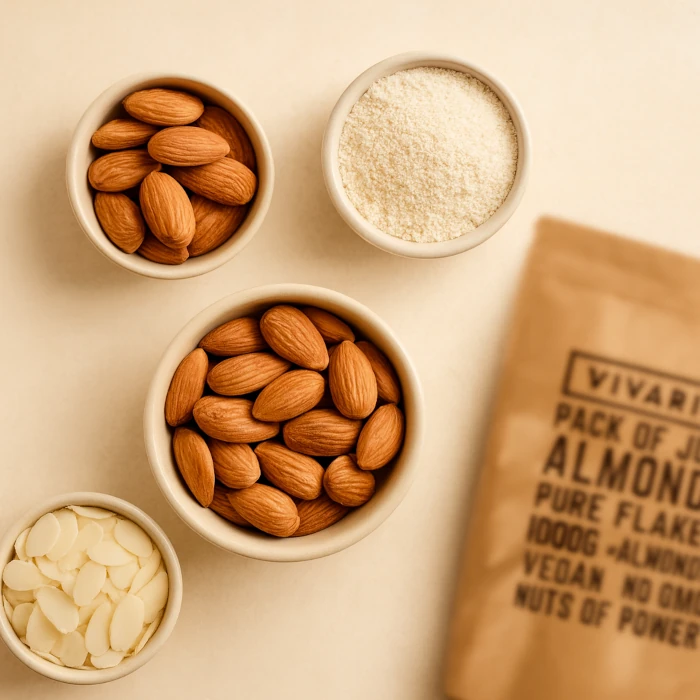
Today, almonds are popular all over the world, and their uses are extremely versatile. They can be eaten natural, as roasted almonds, ground almonds, in the form of almond flakes, almond milk or even almond butter. In our shop, you will find almonds from Vivarini brand: natural, unpeeled almonds and almond flakes, which work perfectly both in baking and everyday meals.
💡 Good to know
There are two main types of almonds found in nature:
- ✔️ sweet almonds,
- ✔️ bitter almonds.
The first – sweet almonds – are the most common and widely used in cooking. These are the ones you’ll find in shops: whole almond nuts, blanched almonds or almond flakes. Bitter almonds, on the other hand, contain amygdalin, a natural compound that can release toxic prussic acid when broken down. For this reason, they are not eaten raw and are used mainly in the cosmetics, perfumery and liqueur industries.
What do almonds look like?
Typical almonds have an elongated, slightly flattened shape. Their colour depends on whether they are shelled or unshelled. Natural almonds with skin are brown and slightly rough, while blanched almonds are much lighter – almost cream-coloured – because their skin is removed by briefly immersing them in hot water.
High-quality almond nuts should be firm, full and free from discolouration. A strong aroma and lack of bitterness are also signs of freshness. In sliced form – as almond flakes – they should be thin, pale and even.
Where and how do almonds grow?
Almond trees thrive best in warm, dry climates typical of the Mediterranean basin, California and parts of Australia. In Google searches, users most often ask: “where almonds grow?” and “how almonds grow?”. The answer is quite simple: almonds grow on trees – or more precisely on shrubby trees belonging to the rose family, the same family as cherries and peaches.
The almond tree blooms very early, even before leaves appear. Its white or slightly pink flowers create a spectacular view but are sensitive to frost, which affects yields. The fruits ripen in summer – inside them is a single seed, the almond itself.
Almonds – nuts or seeds?
Although we commonly call them nuts, from a botanical point of view almonds are seeds. They are the seeds of a fruit that resembles a peach. Just like walnuts or pistachios, almonds are placed in the culinary category of “nuts” only for nutrition and cooking convenience, not classification.

Almond properties – why they are considered healthy?
Almonds have long been recognised as one of the most valuable foods. Another frequently asked question is: “are almonds healthy?”. The answer is quite simple – numerous studies indicate that regular, moderate consumption of almonds can support the body in many ways. This is due to their natural composition: unsaturated fatty acids, vitamin E, fibre, magnesium and a range of polyphenols, especially abundant in the skin.
These ingredients are precisely what contribute to the health benefits associated with almonds. In the following paragraphs, we will explain why almonds appear in the diets of people who care about heart health, the nervous system, skin condition and those wishing to stabilise blood sugar levels.
📌 What almond properties stand out? Summary:
- ✔️ natural source of unsaturated fatty acids,
- ✔️ high vitamin E content – one of the main antioxidants,
- ✔️ contains magnesium and potassium,
- ✔️ low glycaemic index,
- ✔️ high fibre content,
- ✔️ rich in polyphenols, especially in the skin.

Almonds – properties for the heart, brain, immunity and skin
Almond properties most often mentioned are those resulting from their rich nutritional profile. Although they cannot be assigned medicinal action, regular consumption may support various functions of the body as part of a balanced diet.
❤️ Heart
Almonds contain a large amount of unsaturated fatty acids, which – according to epidemiological studies – may help maintain a healthy lipid profile. Studies have observed that regularly including almonds in a balanced diet was associated with favourable changes in metabolic biomarkers.
🧠 Brain
Thanks to their content of vitamin E and magnesium, almonds may support the functioning of the nervous system. Vitamin E is a major antioxidant, and magnesium participates in nerve conduction. No wonder almonds often appear in diets focusing on brain function and concentration.
🛡️ Immunity
Vitamin E, polyphenols and natural fatty acids found in almonds support the proper functioning of the immune system. Research on polyphenol metabolism indicates that almond skin is particularly rich in antioxidant compounds.
✨ Skin
Almonds and almond oil are valued in cosmetics – confirmed by clinical reviews on plant oils in skin care. Components present in almonds, especially vitamin E and unsaturated fatty acids, may support the maintenance of a healthy skin barrier.
💬 Scientific sources:
- M. M. Özcan, A review on some properties of almond: impact of processing, fatty acids, polyphenols, nutrients, bioactive properties, and health aspects, Journal of Food Science and Technology, 2023.
- D. Barreca et al., Almonds (Prunus Dulcis Mill. D. A. Webb): A Source of Nutrients and Health-Promoting Compounds, Nutrients, 2020.
- J. C. King et al., Tree nuts and peanuts as components of a healthy diet, The Journal of Nutrition, 2008.
Almonds and the glycaemic index – are they good for diabetics?
It turns out that almonds have a very low glycaemic index – estimated at around 15. Moreover, studies examining the metabolic effects of almond consumption have shown that almonds may help stabilise post‑meal glucose levels, especially when added to a carbohydrate‑rich meal.
This is due, among other things, to the presence of:
- fibre, which slows down carbohydrate absorption,
- unsaturated fatty acids,
- protein, which increases satiety and moderates digestion.
For this reason, almonds can be a suitable component of a low‑glycaemic diet. This is also why people following low‑carb diets often reach for almonds, ground almonds and almond flour as substitutes for grain‑based flours.
🍽️ Tips for people watching their blood sugar
- ✔️ Add a handful of almonds to carbohydrate‑rich meals – they slow glucose absorption.
- ✔️ Choose natural almonds, unsalted; avoid sugary coated almonds.
- ✔️ Almond flakes and ground almonds work well in low‑carb recipes.

Almonds – nutritional value
Almonds have an exceptionally rich nutritional profile. Although many people associate them with being calorie‑dense, they are in fact one of the most nutrient‑dense plant‑based foods. They contain protein, fibre, healthy fats and a remarkable amount of vitamin E, magnesium, calcium, iron and zinc. This is why they often appear in rankings of natural superfoods.
📊 Almond nutritional value (approx. per 100 g)
- ✔️ Energy: approx. 575-600 kcal
- ✔️ Protein: approx. 20-21 g
- ✔️ Fat: approx. 49-52 g (mainly unsaturated)
- ✔️ Carbohydrates: approx. 20-22 g
- ✔️ Fibre: approx. 12 g
- ✔️ Vitamin E: up to 21 mg per 100 g (one of the highest among nuts)
- ✔️ Magnesium: 154-300 mg
- ✔️ Calcium: 90-330 mg
- ✔️ Potassium: 525-860 mg
- ✔️ Zinc: 1.08-5.5 mg
How many calories are in almonds?
Although almonds are often thought of as high‑calorie, the question “how many calories are in almonds?” has a simple answer: 100 g contains approximately 575-600 kcal. A standard serving, a handful of almonds (about 25-30 g), provides around 150–180 kcal.
Despite this calorie content, almonds are considered a healthy source of energy. This is due to their composition – their unsaturated fatty acids are used more efficiently by the body compared to saturated fats, and their high fibre and protein content increase satiety. This is why almonds often appear in the diets of active individuals and those who want to maintain stable glucose levels.
Protein, fat and fibre content in almonds
In 100 g of almonds we find around 20-21 g of protein, which makes them one of the best plant‑based sources of this macronutrient. This is particularly important for people following a plant‑based diet as well as athletes.
Fats account for around 49-52 g of this portion, but these are mainly unsaturated fats, including oleic and linoleic acids. Meanwhile, fibre (approx. 12 g/100 g) supports digestion and slows the absorption of carbohydrates. Together, these elements help almonds keep you full for longer and support stabilised blood glucose levels.
Importantly, even in processed form – such as ground almonds or almond flour – they retain much of their nutritional value, which is why they often appear in recipes for people following low‑carb diets.
What vitamins and minerals do almonds have?
In terms of micronutrients, almonds are a true treasure trove of substances that support overall wellbeing. The most important include:
- Vitamin E – up to 21 mg per 100 g; one of the strongest naturally occurring antioxidants supporting cell protection.
- Magnesium – 154-300 mg; supports the nervous and muscular systems.
- Calcium – 90-330 mg; important for bones and mineral balance.
- Iron – approx. 4 mg; essential for oxygen transport.
- Zinc – 1.08-5.5 mg; supports immunity and tissue regeneration.
Additionally, almonds are exceptionally rich in polyphenols – around 312 mg per 100 g, with most of them found in the brown skin. These polyphenols have strong antioxidant properties.
What makes almonds a “superfood”?
The term superfood is not an official scientific classification, but it is often used for foods naturally rich in nutrients with proven supportive effects on the body. Almonds fit this category perfectly. Why?
- ✔️ They have a very high nutrient density – a lot of value in a small portion.
- ✔️ They provide polyphenols, tocopherols and phytosterols that help protect cells.
- ✔️ They are a source of plant protein and healthy fats.
- ✔️ They contain vitamins and minerals important for the nervous system, immunity and bone health.
- ✔️ They have a low glycaemic index and a high fibre content.
For these reasons, almonds – including almond flakes, ground almonds and whole natural almond nuts – are commonly included in daily diets of people following traditional, plant‑based, sport or low‑carb eating patterns.

Almonds in the kitchen – how to use them daily
Almonds are one of the most versatile culinary additions. Thanks to their different forms – from whole almond nuts to blanched almonds, roasted almonds, almond flakes and ground almonds – they can be used in countless dishes. They work wonderfully in breakfasts, snacks, desserts and even main dishes, which makes them a great pantry staple. Ideally in a large, economical pack such as Vivarini natural almonds or Vivarini almond flakes.
Whether you enjoy sweet breakfasts, baking or adding crunch to salads – almonds offer endless possibilities!
💡 Culinary fact: Almonds are one of the few foods that work perfectly in both sweet and savoury recipes – which is why chefs and nutritionists appreciate them so much.
Blanched almonds, roasted almonds, almond flakes and ground almonds – how do they differ?
Depending on the type of processing, almonds gain different textures, aromas and uses. Here are the most popular forms worth knowing and using in everyday cooking:
- blanched almonds – skinless, pale, with a milder flavour. Ideal for decorating baked goods, making almond flour or preparing homemade almond butter;
- roasted almonds – more aromatic and crunchy; perfect as a snack, or as an addition to salads, Asian dishes or savoury recipes;
- almond flakes – thin, delicate and very versatile. Perfect for porridge, muesli, smoothie bowls, desserts or as a crunchy topping for savoury meals (e.g. instead of breadcrumbs);
- ground almonds – finely ground, commonly used as a flour substitute in low‑carb and gluten‑free diets. Great for baking, thickening smoothies or preparing fillings and batter.
How to store almonds so they stay fresh and retain their nutritional value?
Almonds contain a significant amount of healthy fats, which means that if stored improperly, they may turn rancid more quickly. To keep them fresh, it’s important to ensure the right storage conditions.
- ✔️ Store almonds in an airtight container – preferably glass or metal.
- ✔️ Protect them from light – UV rays speed up the oxidation of fats.
- ✔️ Avoid moisture – keep almonds in a dry place.
- ✔️ Choose a cool location – a pantry, fridge or freezer.
- ✔️ Don’t leave them open – exposure to air accelerates the loss of crunchiness.

Can almonds be harmful?
Although almonds are considered a valuable and safe product for most people, in some situations they may cause unwanted effects. These usually involve nut allergies or sensitivity to components found in almonds. If you’re wondering: are almonds allergenic? – the answer is yes, they can be, but it’s important to emphasise that – according to epidemiological analyses – the vast majority of people can eat almonds without concern, as long as they do so in moderation and as part of a balanced diet.
In the following paragraphs, we explain what to look out for and which symptoms may indicate almond intolerance.
Almonds and allergies
An allergy to almonds belongs – according to scientific reviews – to the group of tree nut allergies and occurs with varying frequency depending on the region. According to available data, it may affect from a few to over 20% of people allergic to nuts, and the symptoms can vary in severity. The most common allergic reactions include:
- ❌ OAS (oral allergy syndrome) – irritation in the mouth, itching, tingling,
- ❌ hives or skin reactions,
- ❌ gastrointestinal discomfort,
- ❌ respiratory symptoms (cough, wheezing),
- ❌ anaphylaxis – rare, but the most severe type of reaction.
It is also worth noting that almonds may cross‑react with other nuts (e.g. hazelnuts, walnuts), pistachios and certain fruits. Therefore, anyone who notices worrying symptoms after eating almonds should consult an allergist.
Substitutes for people with almond allergies:
- ✔️ sunflower seeds,
- ✔️ pumpkin seeds,
- ✔️ desiccated coconut,
- ✔️ ground flaxseed.
These products tend to have a neutral allergy profile and are often used as replacements for almonds in baking and desserts.
Can everyone eat almonds? What are the contraindications?
For most people, almonds are a safe component of a balanced diet. However, there are certain situations in which their consumption should be limited or discussed with a healthcare professional.
- Allergy or intolerance – the most important contraindication, as mentioned above.
- Digestive problems – individuals with gut sensitivity, inflammatory digestive conditions or IBS may experience discomfort after eating large amounts of fibre. In such cases, almonds should be introduced gradually.
- Very low‑calorie diets – almonds are calorie‑dense (approx. 575-600 kcal/100 g), so portion control is essential.
- Children with nut allergies – almond allergies can also occur in children; consultation with an allergist is necessary in such cases.
Despite these exceptions, almonds are safe for the vast majority of consumers, and their regular, moderate intake can beneficially support the body as part of a balanced diet.

Why include almonds in your diet?
Almonds are one of those foods that combine exceptional flavour, nutritional richness and culinary versatility. As shown by numerous analyses of almond properties and their composition, they make an excellent element of everyday nutrition – for active individuals, those caring for their figure or people who simply want to eat tastier and more nutritiously.
📌 The most important reasons to eat almonds:
- ✔️ they contain healthy unsaturated fats supporting metabolic balance,
- ✔️ they are one of the best sources of vitamin E – a natural antioxidant,
- ✔️ they supply plant protein and fibre, supporting satiety,
- ✔️ they have a low glycaemic index, making them suitable for low‑GI diets,
- ✔️ they are rich in magnesium, calcium, iron and zinc,
- ✔️ their flavour and texture suit hundreds of dishes – from porridge to main meals.
Regular, moderate consumption of almonds is an easy and delicious way to enrich your diet and increase your intake of valuable nutrients. Whether you choose whole almonds, almond flakes, ground almonds or roasted almonds – each version has its own benefits and uses.
If you want to include them in your diet permanently, it’s worth choosing products in larger, economical packaging that stay fresh for a long time and offer plenty of culinary possibilities.
Add almonds to your daily diet and see how much they can change your everyday nutrition!
❓ FAQ – the most frequently asked questions about almonds and their properties
1. How many almonds can you eat per day?
2. Can you eat almonds at night?
3. How can you tell the difference between sweet and bitter almonds?
4. Are almonds allergenic?
5. Are almonds good for diabetics?
6. Do almonds make you gain weight?
Sources of information:
- Wikipedia: Almond.
- M. M. Özcan, A review on some properties of almond: ımpact of processing, fatty acids, polyphenols, nutrients, bioactive properties, and health aspects, Journal of Food Science and Technology, 2023.
- M. Bezerra et al., An Updated Overview of Almond Allergens, Nutrients, 2021.
- D. Barreca et al., Almonds (Prunus Dulcis Mill. D. A. Webb): A Source of Nutrients and Health-Promoting Compounds, Nutrients, 2020.
- J. C. King et al., Tree nuts and peanuts as components of a healthy diet, The Journal of Nutrition, 2008.
Recommended

Vivarini - Natural Almonds (dark) 1kg

Vivarini - Natural Almonds (dark) 250g

Vivarini - Brazil Nuts 1kg
