
Artisan coffee – what is it? Coffee from Bro Coffee Roastery
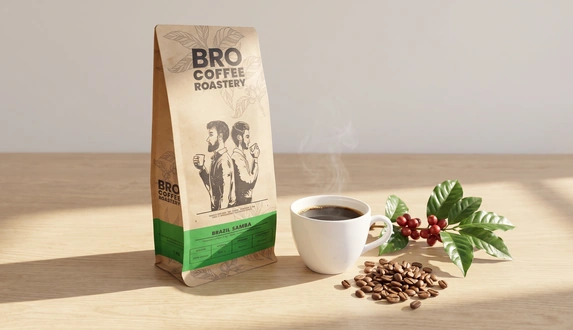
Artisan coffee is a term you see more and more often on coffee bags, on café menus and in online shops. Behind it lies an approach in which every stage of the bean's journey matters – from the farm, through processing and roasting, to the moment the coffee reaches your cup. But what exactly does the term mean, and how is coffee from a roastery different from the coffee we know from supermarket shelves? In this article, we explain it step by step, clearly and without myths. We also show you how to choose fresh coffee beans from a roastery and how to store them so that they keep their aroma for as long as possible.
At MateMundo, we approach coffee in the same way as yerba mate and tea: we want to know where it comes from, how it was prepared and why it tastes the way it does. That is why, in the first part of this article, we look at the whole journey of the bean – from the coffee plant to the finished roasted beans – and compare artisan coffee with mass-produced coffee. The aim is not to name a winner, but to give you the knowledge you need to make an informed choice.
In the second part, we introduce Bro Coffee Roastery – an artisan coffee roastery whose beans you will find in our shop. We suggest which coffee to choose for an espresso machine, a moka pot or pour-over methods, and how to look after the beans once the bag is open. At the end, you will also find answers to the most frequently asked questions.
Table of contents:
- What is artisan coffee?
- How is coffee from an artisan roastery made?
- What affects the flavour of artisan coffee?
- Artisan coffee vs supermarket coffee – the key differences
- Why choose coffee from a roastery?
- Coffee from Bro Coffee Roastery – what you should know
What is artisan coffee?
Artisan coffee is coffee produced with special attention to the quality of the beans, their origin, the way they are roasted and their freshness. It usually comes from a small artisan coffee roastery that buys green coffee from specific regions, or even from specific farms, and roasts it in small batches. This makes it possible to treat each coffee individually and choose a roasting method that best brings out its natural character. If you would like to see how varied such coffees can be, take a look at our coffee category.
One thing is worth making clear from the start: “artisan coffee” is not a formally defined category. There is no single standard or certificate that decides when a coffee may be called that. It is rather a description of a way of working – an approach in which knowledge, care and transparency matter more than the scale of production. That is why, when you choose coffee from a roastery, it is worth looking not only at the wording on the bag, but above all at specific information: the country and region of origin, the processing method, the roast level and the roast date.
💡 Fun fact: Unlike “artisan coffee”, the term specialty coffee does have a definition. The Specialty Coffee Association (SCA), an international coffee industry association, describes specialty coffee as coffee that is recognised for its distinctive attributes, which give it extra value. For years, in practice, this group was taken to include coffees scored by trained tasters at 80 points or more on the 100-point SCA scale. All Bro Coffee Roastery coffees available at MateMundo score above this threshold.
The question “what is artisan coffee?” is most often asked by people who have so far bought their coffee in the supermarket and suddenly notice bags on the shelves showing the name of a region, the growing altitude or a list of flavour notes. This is a natural moment when coffee stops being just a drink to wake you up and becomes a product you can explore, much like tea, chocolate or yerba mate.
How is artisan coffee different from mass-produced coffee?
Mass-produced coffee and coffee from an artisan roastery are two different production models, and each has its strengths. Large industrial roasteries roast huge quantities of beans and usually combine coffees from many sources into blends, so that the flavour is the same in every pack, all year round. This kind of coffee is easy to find, predictable and usually cheaper. The downside of this model can be less information about the origin of the beans and a longer time between roasting and brewing.
An artisan roastery works on a smaller scale, which allows it to focus on the details. The key differences usually concern a few areas:
- ➡️ scale of production – coffee is roasted in smaller batches, and each batch is easier to control and assess,
- ➡️ information about the beans – the bag usually shows the country and region, and often also the botanical variety, growing altitude and processing method,
- ➡️ roasting method – the roast profile is chosen for a specific coffee rather than set for a whole blend,
- ➡️ freshness – the coffee goes on sale shortly after roasting, and the bag usually shows the roast date,
- ➡️ variety of flavours – instead of one universal taste, you can choose from coffees with chocolate, nutty, fruity or tea-like notes.
This does not mean that every artisan coffee is automatically better than every supermarket coffee. Quality depends on the specific beans and the specific roastery, and in the end on your own taste as well. The difference is rather that coffee from a roastery gives you more information and more choice. You will find a more detailed comparison of the two types of coffee later in this article.
Craft coffee vs artisan coffee
What is craft coffee, and how is it different from artisan coffee? In practice, both terms describe the same thing. The name “craft coffee” is used in many countries for coffee from small roasteries, much like “craft beer” for beer. The two terms are used interchangeably and describe coffee where the producer's approach matters, not just the size of production.
Whatever you call them, artisan coffee beans share the features described above: they are produced in smaller batches, have an individually chosen roast profile, are fresh and come with clear information. The difference between “craft” and “artisan” is therefore only a matter of wording, not of the coffee itself.
📌 In short:
Artisan coffee and craft coffee are terms used interchangeably. They are not a formal category, but a description of an approach in which the quality of the beans, careful roasting in smaller batches, freshness and transparent information about origin all matter.
Now that we know what artisan coffee is, it is time to see how it is made. In the next part, we follow the whole journey of the bean – from the flowering coffee plant, through harvesting and processing, to roasting and packing. It is at each of these stages that decisions are made which you can later taste in your cup.
How is coffee from an artisan roastery made?
Before coffee from an artisan roastery reaches your grinder, it goes on a long journey made up of many stages and many decisions. Each of them affects what you will finally taste in your cup, and each can improve or spoil the flavour. With artisan coffee, a lot of attention is paid to this whole journey, and information about it often appears on the bag.
In simple terms, the whole process looks like this:
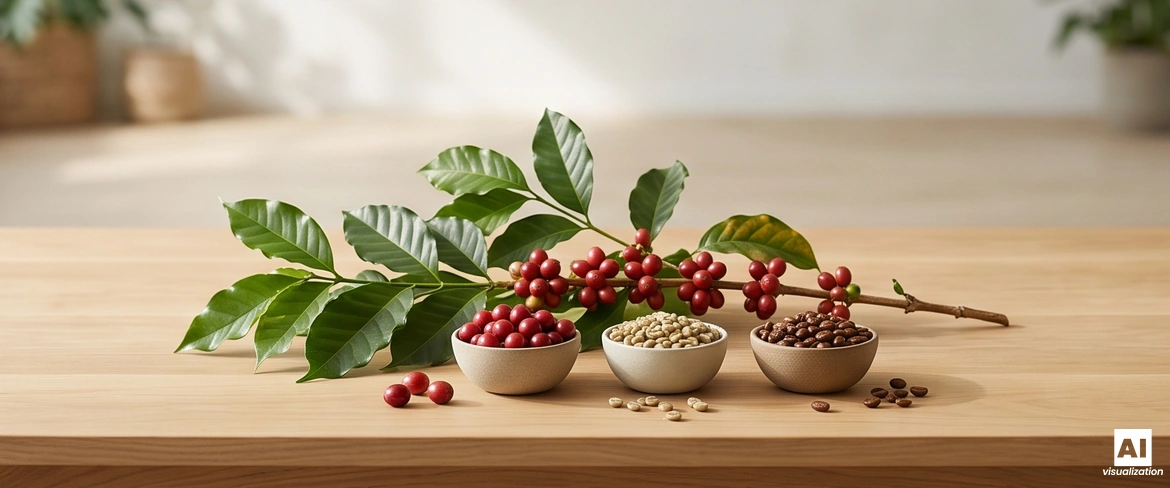
- growing and harvesting – the coffee cherries ripen on the plants and are then picked,
- processing – the seeds are removed from the fruit and dried to the right moisture level,
- sorting – the green coffee is sorted and assessed, and defective beans are removed,
- roasting – at the roastery, the green beans turn into aromatic brown coffee,
- packing and resting – the roasted coffee goes into its packaging and, for a few days, releases the gases formed during roasting.
Growing and harvesting coffee cherries
Coffee does not grow as ready-made beans. Coffee plants produce fruit which, because of its shape and colour, is called coffee cherries. Inside each cherry there are usually two seeds – these are what become coffee beans after processing and roasting. Coffee is grown in the tropical belt, in countries of Central and South America, Africa and Asia. You will find an overview of coffees from different parts of the world in our coffee by country category.
The flavour of the future coffee depends on the conditions in which the plant grows: climate, soil, amount of sunshine and rainfall, and also growing altitude. Arabica, the species most coffees from artisan roasteries come from, grows best high up in the mountains. In a cooler climate, the cherries ripen more slowly and the beans have more time to develop a complex flavour. That is why the bags of roastery coffees often show the growing altitude, for example 1200-2000 metres above sea level.
💡 Fun fact: A study of arabica coffee from farms in Ethiopia found that, as growing altitude increased, the sucrose content of the green beans rose, while their caffeine and chlorogenic acid content fell. However, this relationship was not the same in all samples – the effect of altitude on sugar content was clear in washed coffee, but turned out to be insignificant in coffee dried as whole cherries. It is a good example of how the flavour of coffee depends on many factors at once.
💬 Scientific source: M. Worku et al., Effect of altitude on biochemical composition and quality of green arabica coffee beans can be affected by shade and postharvest processing method, Food Research International, 2018.
The timing of the harvest is just as important. Cherries on a single plant do not ripen at the same time, so on quality-focused farms they are picked by hand, in several rounds, selecting only the fully ripe ones. Unripe cherries give coffee an astringent, “green” taste, while overripe ones can introduce fermented notes. Selective hand-picking is labour-intensive, but it is the first step towards a clean, sweet flavour in the cup.
Processing coffee beans
After harvesting, the seeds must be separated from the fruit and dried. The way this is done is called processing. It is one of the stages that has the strongest influence on the character of coffee – the same coffee processed in two different ways can taste completely different. You will most often come across three methods:
- ➡️ natural – the whole cherries are dried in the sun together with the pulp, and the seeds are separated only after drying. The coffee usually has more noticeable sweetness, a fuller body and notes of ripe fruit or chocolate,
- ➡️ washed – the pulp is removed straight after harvesting, and before drying the seeds are fermented and rinsed with water. The coffee usually has a clean, clear flavour and more pronounced acidity,
- ➡️ honey – the pulp is removed, but part of the sticky layer around the seeds stays on them during drying. The coffee combines features of both previous methods: it has plenty of sweetness while remaining relatively clean in flavour.
None of these methods is “the best” – each leads to a different result. Naturally processed coffees are often chosen by people who like sweet, dessert-like profiles and a full body. We recommend washed coffees to those who value clarity of flavour and want to taste fruity or floral notes in the cup. The processing method is one of the pieces of information worth checking on the bag before you buy.
💡 Fun fact: Scientists compared roasted arabica processed by three methods: natural, washed and honey. They detected 176 volatile compounds responsible for aroma in the beans. The natural and washed coffees differed in as many as 32 of them, while the honey and washed coffees differed in only 9. This means that, in terms of aroma, the honey method in this study was much closer to the washed method than to the natural one.
💬 Scientific source: X. Shen et al., Effects of Different Primary Processing Methods on the Flavor of Coffea arabica Beans by Metabolomics, Fermentation, 2023.
Sorting green coffee
The dried and cleaned seeds are known as green coffee. Before it reaches the roastery, it is sorted and graded. The beans are separated by size and density, and those with defects are removed – for example beans that are black, unripe, damaged by insects, broken or over-fermented. On farms and at processing mills, this is done with sieves, gravity tables and optical sorters, and often by hand as well.
Sorting may seem like an unspectacular stage, but it matters a great deal. Even a small number of defective beans can change the flavour of a whole batch. Well-sorted coffee, on the other hand, makes it possible to use the full potential of the raw material and allows the roastery to choose a roast profile for beans of similar size and density, which roast evenly.
💡 Fun fact: A study showed that defective beans – black, unripe and sour (over-fermented) – have a different composition of volatile compounds from good-quality beans and clearly lower the quality of the brew. This is why so much importance is attached to removing them before roasting.
💬 Scientific source: R. D. C. C. Bandeira et al., Composição volátil dos defeitos intrínsecos do café por CG/EM-headspace, Química Nova, 2009.
Roasting coffee at the roastery
Roasting is the moment when green, almost odourless beans turn into aromatic coffee. In the drum of the roasting machine, the beans gradually heat up, lose water, change colour and grow in size. Hundreds of chemical reactions take place inside them, including Maillard reactions and the caramelisation of sugars, which create the compounds responsible for the taste and smell of coffee. At a certain point, the beans start to crack audibly – a sign for the roaster that the process is entering a key phase.
The person in charge of roasting, called the roaster, decides on the temperature, the time and the rate at which the beans heat up. This set of settings is called the roast profile. It determines whether the coffee will be more acidic and fruity or rather sweet and chocolatey, and whether it will have a light or a full body. In an artisan roastery, the roast profile is chosen individually for each coffee, taking into account its origin, bean density and processing method. This often requires several test roasts and tastings before the coffee goes on sale.
In simple terms, there are three main roast levels:
- ➡️ light roast – brings out the natural character of the bean, its acidity and its fruity and floral notes; works especially well in pour-over methods,
- ➡️ medium roast – combines sweetness, balance and a distinct aroma; a versatile choice for many brewing methods,
- ➡️ dark roast – gives an intense flavour with noticeable bitterness and roasted notes, but with a very dark roast the natural character of the bean becomes less and less noticeable.
💡 Fun fact: In one study, the same coffee was roasted to four different levels – from very light to extremely dark. The medium-roasted coffee had pleasant notes of sweetness, roasted hazelnuts and caramel. In the extremely dark roast, on the other hand, burnt and sulphurous notes dominated. This shows how much the roaster's decision about when to end the roast affects the aroma.
💬 Scientific source: A. M. Obando and J. G. Figueroa, Effect of Roasting Level on the Development of Key Aroma-Active Compounds in Coffee, Molecules, 2024.
Packing and resting coffee after roasting
Freshly roasted coffee is not yet ready for brewing. During roasting, gases form in the beans, mainly carbon dioxide. Some of them are trapped in the porous structure of the bean and are released gradually over the following days and weeks – and very quickly during grinding and brewing. If you brew coffee right after roasting, the escaping gas can make it harder to extract the flavour evenly. That is why coffee needs a few days of resting before it shows its full potential.
The same process explains why good coffee packaging has a one-way valve. This valve lets the gas released by the beans escape, but does not let air in. As a result, the packaging does not swell, and the coffee is protected from oxygen, which speeds up the loss of aroma. The packaging material and a tight seal are just as important: the better they protect against air, light and moisture, the longer the coffee stays fresh.
🔍 Good to know: According to the Specialty Coffee Association, whole coffee beans can be considered fresh for about three weeks after roasting, and they release the most carbon dioxide during the first 20 days. Once ground, the same process takes only a few minutes – which is why it is best to grind coffee just before brewing.
Coffees from artisan roasteries usually show the roast date on the bag, not just the best-before date. It makes it easy to judge whether the coffee is fresh and when it is best to start brewing it. We explain more about reading the roast date in the section comparing artisan coffee with supermarket coffee.
This is the journey of the bean from the plant to the bag. Now that we know it as a whole, it is easier to understand where differences in flavour come from. In the next part, we bring all these factors together and explain what actually affects the flavour of artisan coffee and what the flavour notes on the bag mean.
What affects the flavour of artisan coffee?
The flavour you taste in your cup never depends on chance or on a single factor. Artisan coffee shows this particularly clearly, because roasteries try to preserve and highlight what is most distinctive about particular beans. The final result is shaped by the growing conditions, the work of people on the farm, the roaster's decisions and the way you prepare your brew. Each of these elements can shift the flavour towards sweetness, acidity, bitterness or fruitiness.
We have already met some of these factors while following the bean from the plant to the bag. Now we gather them in one place and show how they influence one another. This will make it easier for you to read coffee descriptions and predict whether you will enjoy a particular coffee.
Origin, variety and growing altitude
The starting point is the origin of the coffee. Every region has its own climate, type of soil and growing traditions, which is why coffees from different parts of the world often have a recognisable character. Coffees from East Africa, for example from Kenya, are known for their bright acidity and fruit notes such as blackcurrant. Coffees from Central and South America are more often associated with chocolate, nuts and caramel, as well as good balance – you can read more about one of the most important coffee regions in the world in our article The history of Brazilian coffee – from discovery to global success. Coffees from Asia, for example from India, can in turn be full-flavoured, with a noticeable body. These are, of course, generalisations – in every country you can find coffees with very different profiles.
The botanical variety also matters. Within the arabica species there are many varieties, such as Bourbon, Typica, Caturra and SL28, which differ in cherry size, disease resistance and flavour potential. Then there is the growing altitude: at higher altitudes, the cherries ripen more slowly, which favours a more complex flavour. That is why roasteries put this information on their bags – it helps you predict what to expect from a coffee before you even brew it.
Processing and roast profile
The next two factors are the processing method and the roast profile. As we wrote earlier, natural processing usually gives coffee more sweetness and fruitiness, while washed processing gives a cleaner flavour and more pronounced acidity. Roasting, in turn, decides which features of the bean are brought to the fore: a lighter roast highlights natural acidity and fruity notes, while a darker roast strengthens the body, caramel sweetness and bitterness.
Two coffees from our range show this well. Brazil Guaxupe Premium and Amico dall'Italia Espresso Roast from Bro Coffee Roastery come from the same region of Brazil and the same varieties, and are processed using the same method. The first is roasted to a medium light level, the second a little darker, to a medium level. The result? Guaxupe has a medium body and is versatile, while Amico dall'Italia has a fuller body and a more intense character that works perfectly in espresso and milk-based coffees.
Freshness and brewing method
Even the best-roasted coffee loses its aroma over time. Freshness is a factor you have real influence over – you will find details in the section on the differences between coffees and in the section on storage. Coffee that has been open for a long time gradually loses its most delicate notes and starts to taste flat.
The last element is the brewing method. The same coffee can taste different in an espresso machine, a moka pot and pour-over methods. Espresso concentrates the flavour and highlights body and sweetness, while pour-over methods, such as a dripper or a Chemex, give a lighter brew in which fruity and acidic notes are easier to taste. For example, Brazil Guaxupe has a chocolate and nut profile as espresso, but a lighter, clean character with a clear note of orange from a dripper. Grind size, water temperature, ratios and brewing time also make a difference.
To sum up, the flavour of artisan coffee is affected by:
- ✔️ origin and variety – they set the natural flavour potential of the beans,
- ✔️ growing altitude – it affects the speed of ripening and the complexity of flavour,
- ✔️ processing method – it shifts the flavour towards sweetness and fruitiness or towards cleanness and acidity,
- ✔️ roast profile – it decides which features of the bean are brought to the fore,
- ✔️ freshness – it helps preserve the full aroma,
- ✔️ brewing method – it draws out different features of the coffee depending on the method.
What do the flavour notes on the bag mean?
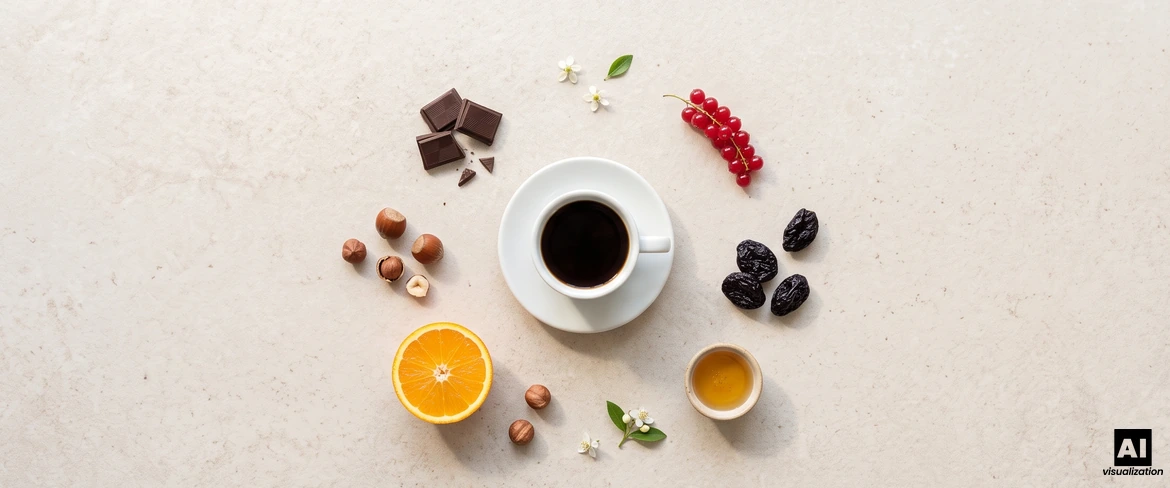
On the bags of roastery coffees you will often find a description such as “blackcurrant, black tea, honey” or “chocolate, nuts”. It is worth knowing that flavour notes describe aromas you can taste in the brew, not added ingredients. A coffee with blackcurrant notes contains no blackcurrants, and a coffee with chocolate notes contains no chocolate. They are simply associations that help describe the aroma and taste. They come from compounds that form in the bean as it grows, is processed and is roasted, and some of these compounds are also found in fruit, flowers or cocoa.
💡 Fun fact: More than 1000 volatile compounds, which are responsible for smell, have been identified in roasted coffee. However, it is estimated that we can detect only a small share of them – about 5% – with our sense of smell. It is these compounds that shape the aroma of coffee the most and make us find such different notes in different coffees.
💬 Scientific source: P. Zakidou et al., Single Origin Coffee Aroma: From Optimized Flavor Protocols and Coffee Customization to Instrumental Volatile Characterization and Chemometrics, Molecules, 2021.
Flavour notes are best treated as a guide, not a promise. How you perceive them depends on your sensitivity and experience, and also on the brewing method. If you are just starting to explore roastery coffees, choose by general direction: notes of chocolate, nuts and caramel usually mean a mild, sweet coffee, while notes of fruit and citrus mean a more distinctive, acidic one. Over time, you will start to recognise more and more details, and it will become easier to choose coffees that suit your own preferences.
Knowing what affects the flavour of coffee makes it easier to look at the differences between artisan coffee and the coffee we buy in the supermarket. In the next part, we compare the two in terms of freshness, information on the bag, variety of flavours and quality control – factually and without oversimplifying. You will also see that both have their strengths.
Artisan coffee vs supermarket coffee – the key differences
It is easy to reduce a comparison of artisan coffee and supermarket coffee to a simple “better or worse”. The reality, however, is more complex. Supermarket coffee has its advantages, which we mentioned at the beginning. Coffee from a roastery, on the other hand, offers more information, greater freshness and a much wider choice of flavour profiles. Which one will suit you better depends on what you expect from your everyday cup.
Below we set out the key differences, and in the following subsections we discuss them in more detail. Remember that this is a comparison of typical features – there are exceptions among both supermarket and roastery coffees.
Artisan coffee vs supermarket coffee – a comparison
| Feature | Artisan coffee | Typical supermarket coffee |
|---|---|---|
| Freshness | roasted regularly, in small quantities, shortly before sale | roasted in large batches, often long before purchase |
| Date on the bag | roast date (and best-before date) | usually only the best-before date |
| Information on origin | country, region, variety, growing altitude, processing method | often only the country or a general blend name |
| Flavour profile | varied, described with flavour notes | uniform, consistent all year round |
| Batch size | smaller batches, profile chosen for a specific coffee | large batches, profile usually set for the whole blend |
| Availability and price | mainly at roasteries and specialist shops, usually a higher price | in every grocery shop, usually a lower price |
Freshness and roast date
One of the most practical differences is the way the producer informs you about the freshness of the coffee. On supermarket coffee packaging, you will usually find only a best-before date, which is the date until which the producer guarantees that the product keeps its properties. For roasted coffee, it can be many months away. This does not mean the coffee is spoiled by then – but it also tells you nothing about when the beans were roasted or whether they are at their peak.
Roastery coffees usually show the roast date on the bag. This is much more valuable information, because it lets you judge how long ago the coffee was roasted. As we mentioned in the section on packing, freshly roasted beans need a few days of rest, and then show their full aroma for the next two or three weeks. Thanks to the roast date, you know when to start brewing the coffee and by when it is best to finish it. Many roasteries also state directly how many days after roasting the coffee tastes best.
🔍 Good to know: The roast date and the best-before date are two different pieces of information. The first tells you about freshness and the best moment to brew, the second about how long the product keeps its properties. When choosing coffee beans from a roastery, it is the roast date that you should look at first.
Information on the origin of the beans
The second difference concerns the amount of information you get with the coffee. Supermarket coffee packaging often shows only the country of origin or a general blend name. Roastery coffee usually reveals much more. On the label or in the product description, you can find the country and region, sometimes even the specific farm, as well as the botanical variety, growing altitude, processing method, roast level and flavour profile.
This information is more than just a curiosity. As we showed earlier, each piece of it affects the flavour of the coffee. It allows you to compare coffees, go back to the ones you liked and consciously look for similar or completely different profiles. Over time, you may notice, for example, that naturally processed coffees from Brazil suit you better than washed coffees from Africa – or the other way round.
🏷️ Example: what does a roastery coffee description tell you?
This is the profile of Brazil Cerrado Premium coffee from Bro Coffee Roastery:
- 🌍 origin: Brazil, Cerrado region, Minas Gerais,
- ⛰️ growing altitude: 900-1250 m above sea level,
- 🌱 varieties: Bourbon, Catuai, Mundo Novo,
- 💧 processing: natural,
- 🔥 roast level: medium light (3/5),
- 🍫 flavour profile: sweet aftertaste, lemon, roasted almonds, chocolate; heavy body and medium acidity.
A description like this tells you a lot before you even open the bag: that it is a sweet, chocolatey coffee with a full body that will work well in espresso and milk-based coffees.
Variety of flavour profiles
Supermarket coffee is usually made to taste the same in every pack. This is an advantage for people who like predictability, but it also means that its flavour is more universal and less distinctive. Roastery coffees, on the other hand, show what a huge variety of flavours coffee can have. In the range of a single roastery, you will find coffees with very different profiles:
- ➡️ chocolate and cocoa – mild, sweet and a good match for milk,
- ➡️ nutty and caramel – balanced, dessert-like and versatile,
- ➡️ fruity – with notes of red fruit, cherry, plum or currant,
- ➡️ citrus – refreshing, with a clear acidity reminiscent of orange, lemon or grapefruit,
- ➡️ floral and tea-like – delicate, light and best explored with pour-over methods.
This variety comes from everything we described earlier: the origin of the beans, their processing, roasting and the way they are prepared. That is why coffee from a roastery is a good choice for people who enjoy trying new flavours. If you are wondering how coffee differs from other energising drinks, read our article Yerba mate or coffee – what to choose?
Quality control and batch size
Artisan roasteries roast coffee in smaller batches. This makes quality control easier: each batch can be assessed, tasted and, if necessary, the roast profile can be adjusted for the next roast. The roaster works directly with the beans and can respond to differences between deliveries of green coffee, for example by changing the temperature or roasting time. This supports consistency and attention to every detail.
It is worth stressing, however, that batch size alone does not guarantee quality. Large industrial roasteries also use advanced control systems, and a small roastery can make mistakes. Quality depends above all on the raw material, on the knowledge and experience of the people who work with the coffee, and on how much importance they attach to the details. A smaller scale simply gives more opportunities to take care of those details.
📌 In short:
Supermarket coffee focuses on availability, predictability and a lower price. Artisan coffee focuses on freshness, transparent information, a variety of flavours and care for every batch. Both have their place, and the choice depends on what you are looking for in your cup.
Now that we know the differences, it is time to gather the practical arguments for coffee from a roastery. In the next part, we suggest who it is a particularly good choice for and what to look out for when buying it for the first time. It is a good starting point before we move on to specific coffees from our range.
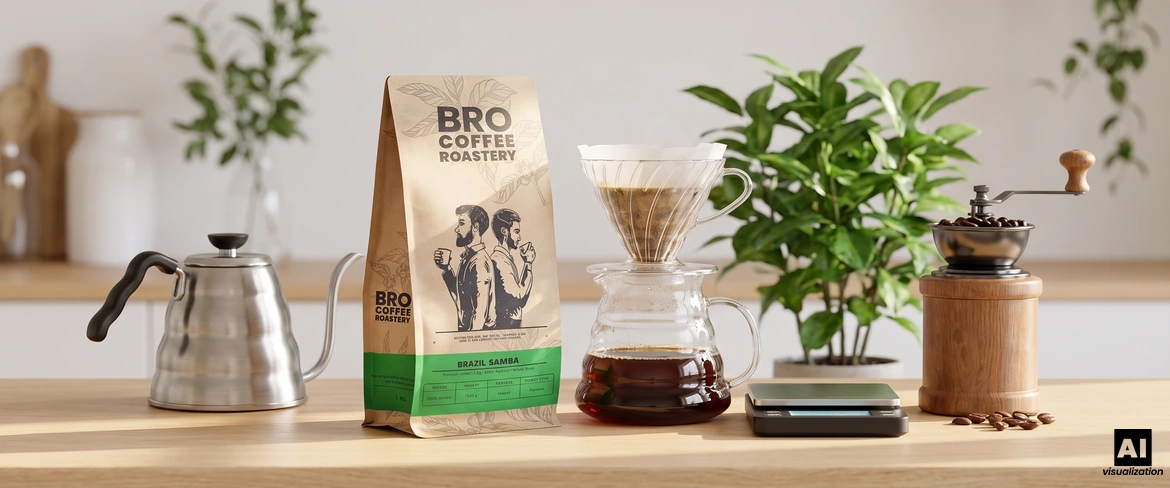
Why choose coffee from a roastery?
Now that you know how coffee is made and what affects its flavour, it is easier to answer the question of what you really gain by choosing coffee from a roastery. It is not about fashion or the word “artisan” on the bag, but about specific benefits you can taste in everyday brewing. Here are the most important ones:
- ✔️ freshness – the coffee reaches you shortly after roasting, and the roast date on the bag lets you brew it when it tastes best,
- ✔️ knowing the origin – you know where the beans come from, how they were processed and how they were roasted, so you can choose and compare coffees consciously,
- ✔️ variety of flavours – you can explore chocolatey, fruity, citrus or tea-like coffees and look for the ones that suit you best,
- ✔️ matching the brewing method – roasteries often suggest which equipment a coffee works best in, which makes it easier to choose beans for an espresso machine, a moka pot or a dripper.
Coffee from a roastery is a good choice above all for people who want to explore the world of coffee more consciously. If you like to know what you drink, enjoy trying new flavours or want to get more out of your home coffee machine than before, coffee beans from a roastery will give you far more possibilities than coffee chosen without any information about its origin. You do not need specialist knowledge – curiosity and a few basic rules are enough.
How do I choose roastery coffee for the first time?
Your first purchase from a roastery can seem difficult, because there are quite a lot of descriptions and parameters. In practice, it is enough to answer a few questions:
- How do you brew your coffee? For espresso machines and moka pots, coffees with a full body and chocolate notes usually work better, while for pour-over methods, coffees with a lighter roast and a fruity profile are a better fit. Pay attention to the roastery's brewing suggestions.
- Which flavours do you like? If you prefer mild, sweet coffees, look for notes of chocolate, nuts and caramel. If you like a distinctive, refreshing cup, choose a coffee with notes of fruit or citrus.
- When was the coffee roasted? Check the roast date and plan to start brewing the coffee about a week after roasting.
- How much coffee do you drink? Buy as much coffee as you will use within a few weeks of opening. A larger bag makes sense if you drink coffee every day, a smaller one if you want to try several different coffees first.
- Do you have a grinder? Coffee beans ground just before brewing keep the most aroma, so a grinder is one of the simplest ways to make better coffee at home.
A good way to start is to choose two coffees with clearly different profiles, for example one chocolatey coffee from Brazil and one fruity coffee from Africa, and compare them using the same equipment. This simple test quickly shows how different coffee can be and helps you identify your own preferences.
This brings us to the second part of the article. Now we will put this knowledge into practice: we introduce the brand whose coffees you will find at MateMundo and show you how to match its beans to the way you brew. With specific coffees, it will be easier for you to test the rules described above in practice.
Coffee from Bro Coffee Roastery – what you should know
Now that you know what artisan coffee is and what to look out for when choosing it, it is time to get specific. At MateMundo, you will find coffees from Bro Coffee Roastery – an artisan roastery that combines a careful selection of beans with roasting in small batches and attention to freshness. Its range includes both versatile everyday coffees and coffees with distinctive, fruity profiles for those who enjoy discovering new flavours. At the end of this part, you will also find practical tips on how to store the beans so that they keep their full aroma for as long as possible.
Bro Coffee Roastery – an artisan approach to coffee
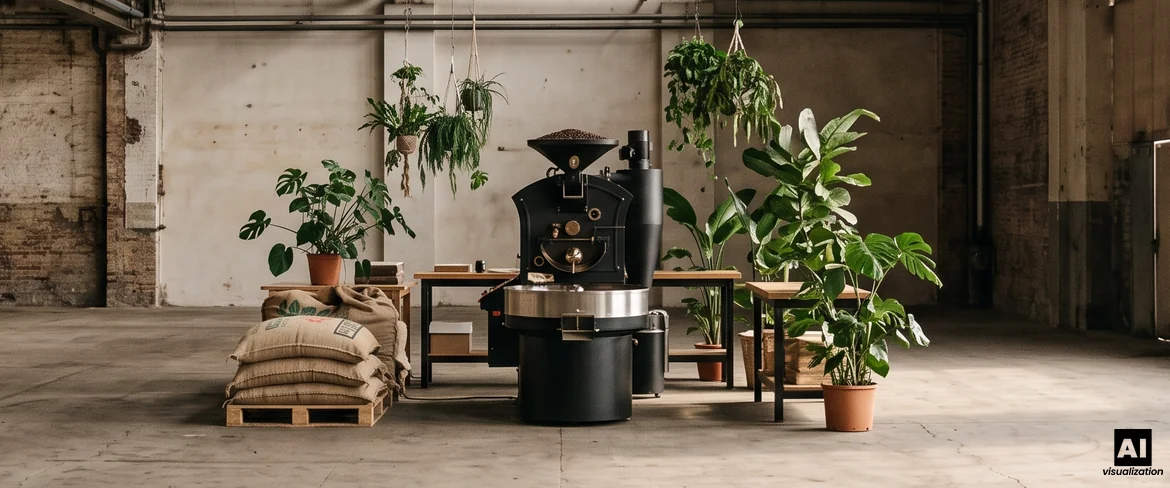
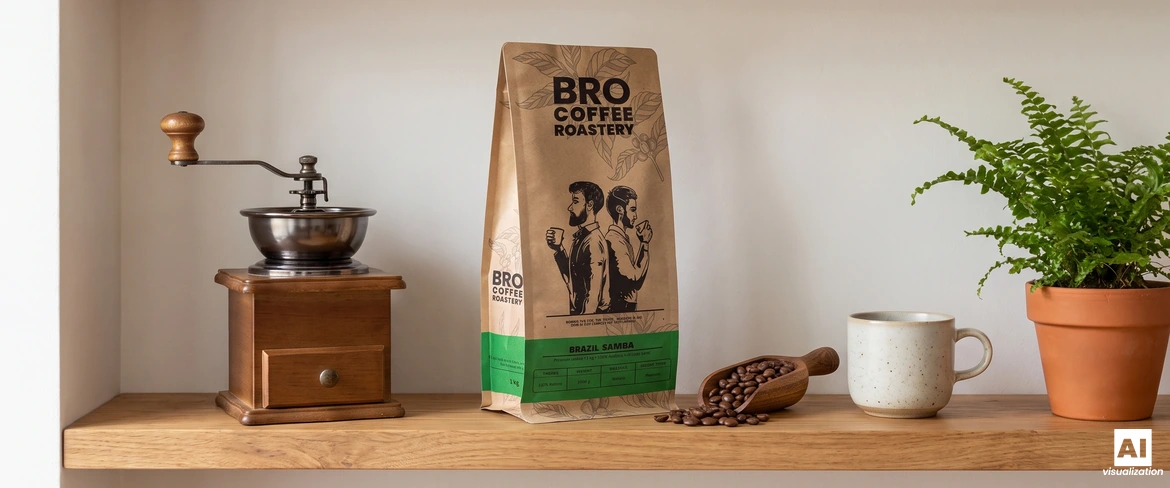
Bro Coffee Roastery is an artisan coffee roastery that roasts its beans on site, in its own roasting machine, in small batches. This scale allows it to control the whole process precisely and match the roast profile to each coffee individually. Most of the brand's coffees are roasted to a medium light level, which shows the natural character of the beans well – their origin, processing and flavour notes. There are two exceptions: Brazil Samba, roasted to a versatile medium omniroast level that works in many brewing methods, and Amico dall'Italia Espresso Roast, roasted darker (medium 4/5) with espresso in mind.
The brand focuses on the ethical sourcing of beans and sustainable development, and the producer is an official member of the Specialty Coffee Association. All Bro Coffee Roastery coffees available at MateMundo score above 80 points on the SCA scale. The beans are roasted on an ongoing basis and packed in doypacks with a one-way valve, a zip closure and an additional inner layer that protects the coffee from air and light. With each coffee, you will find detailed information, including its origin, processing method, roast level, flavour notes and recommended brewing methods.
You can learn more about the brand and its philosophy on the official Bro Coffee Roastery website. The producer also points out that the coffee tastes best at least 7 days after the roast date – this is the time the beans need to release excess gases and for their flavour to settle.
Which Bro Coffee Roastery coffees will you find at MateMundo?
In our shop, you will find Bro Coffee Roastery coffee beans from different parts of the world – from versatile coffees from Brazil, through coffees from Colombia and India, to coffees from the Speciality line from Africa and Central America. Many of them are available in two pack sizes. Let us start with the coffee that is the most important item in the brand's range.
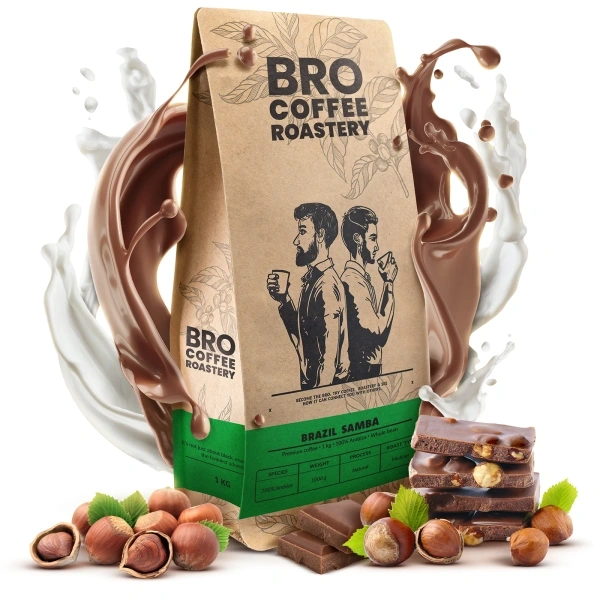
☕ Brazil Samba Premium – a versatile coffee for every day
Brazil Samba Premium is the most important coffee in the Bro Coffee Roastery range and the best starting point for discovering roastery coffees. Why?
- 🍫 Notes of chocolate and nuts – a classic, mild profile that appeals to a great many people.
- ⚖️ Medium body and medium acidity – a balanced flavour without sharp, sour notes.
- 🔥 Versatile medium roast – known as omniroast, which works in an espresso machine, a moka pot, a French press, an AeroPress and a dripper.
- ⭐ 84 points on the SCA scale – natural processing, 100% arabica from Brazil.
This is a coffee you can brew every day, whatever your equipment, and it tastes great both black and with milk.
Coffees from Brazil
Apart from Samba, the brand's range includes three more coffees from Brazil. All of them are naturally processed and have a sweet, chocolatey character, but each has a slightly different flavour profile.
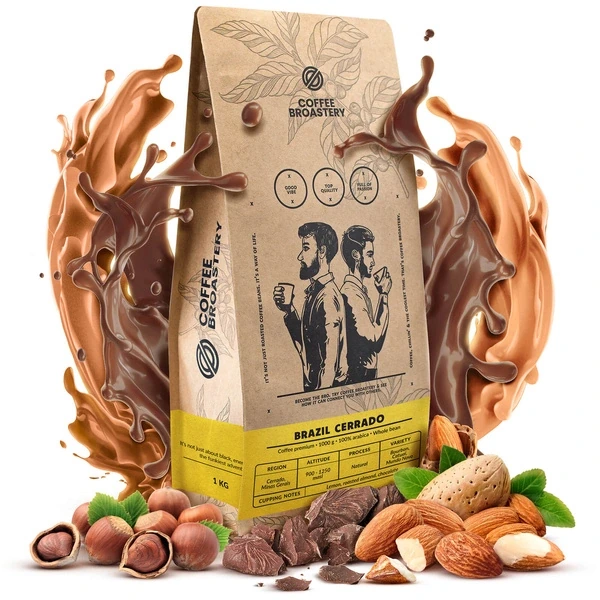
A sweet coffee with notes of lemon, roasted almonds and chocolate and a heavy body. Excellent for espresso, milk-based coffees, a moka pot and a French press.
Notes of orange, hazelnuts and milk chocolate. Versatile – chocolatey and nutty as espresso, lighter and more citrusy from a dripper.

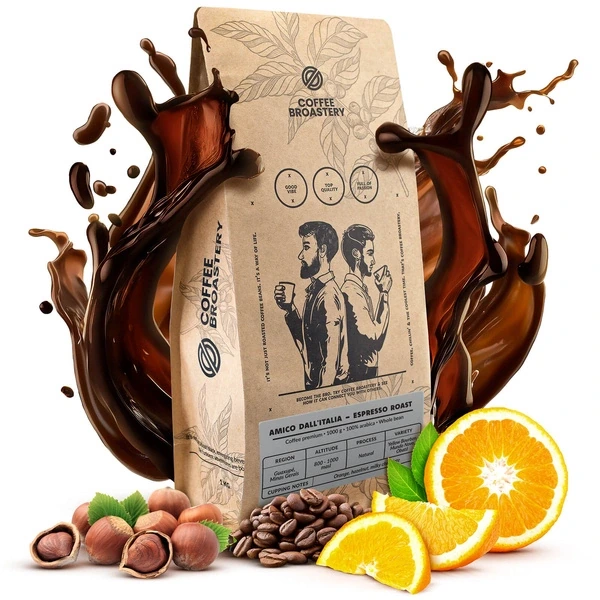
Roasted darker than most of the brand's coffees (medium 4/5) and created with espresso in mind. A full body, thick crema and a chocolate and nut aroma – also as a base for cappuccino and latte.
Premium line coffees from Colombia and India
Premium and Speciality are the names of the brand's product lines – all the coffees, whatever the line, score above 80 SCA points and are specialty coffees. The Premium line coffees from Colombia and India are two washed coffees that combine sweetness with more pronounced acidity. They are a good choice for people who want to go beyond the classic chocolatey profile but are not yet looking for very fruity coffees.
A coffee grown at an altitude of 1200-2000 m above sea level, with notes of redcurrant, orange, caramel and chocolate. A sweet espresso and a clean brew from a dripper or a Chemex.

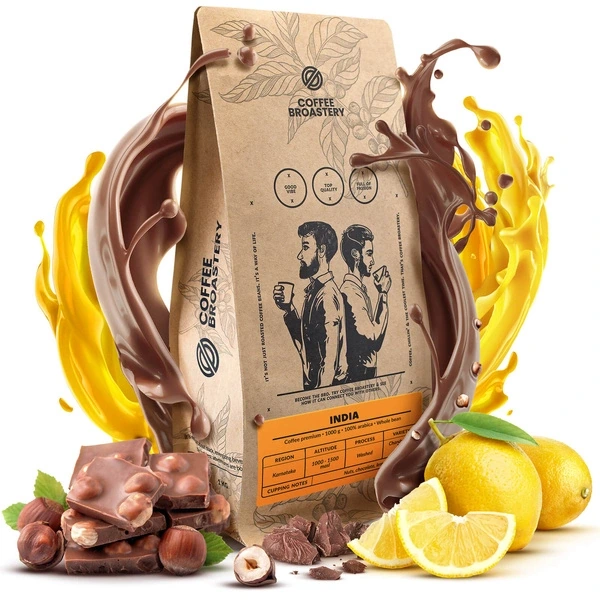
A coffee from the Karnataka region in India, with notes of nuts, chocolate and lemon. It has a heavy body and a sweet citrus acidity. It works well in coffee machines, a moka pot, a French press and pour-over methods.
Speciality line coffees from Africa and Central America
These are the most distinctive coffees in the brand's range. All of them are washed and have complex, often fruity profiles that come through best in pour-over methods – although many of them also work well as espresso.
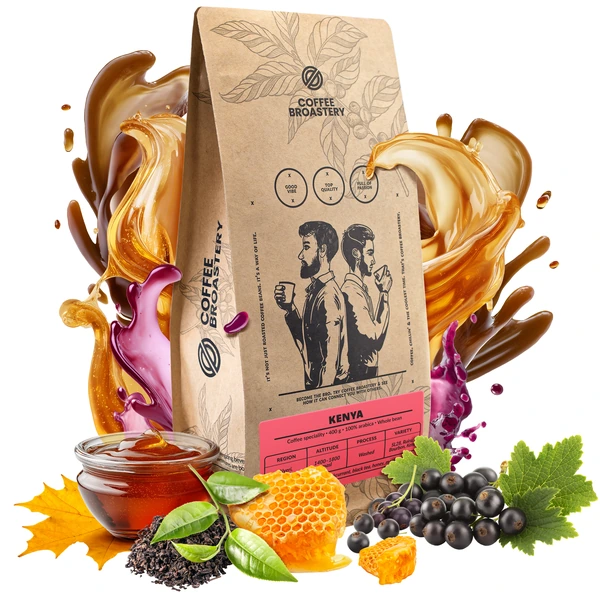
A coffee from the slopes of Mount Kenya with notes of blackcurrant, black tea, honey, maple syrup and cedar. Excellent in a V60, a Kalita and an AeroPress.
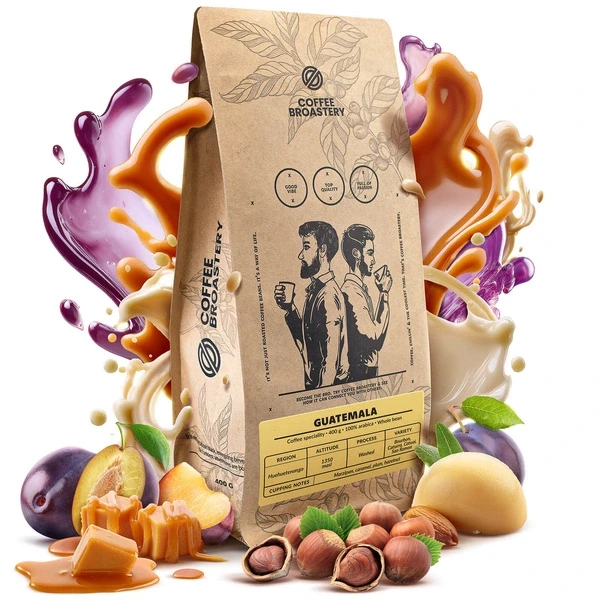
Notes of marzipan, caramel, plum and hazelnuts, low acidity and a heavy body. Good as a pour-over, as espresso and in milk-based coffees.
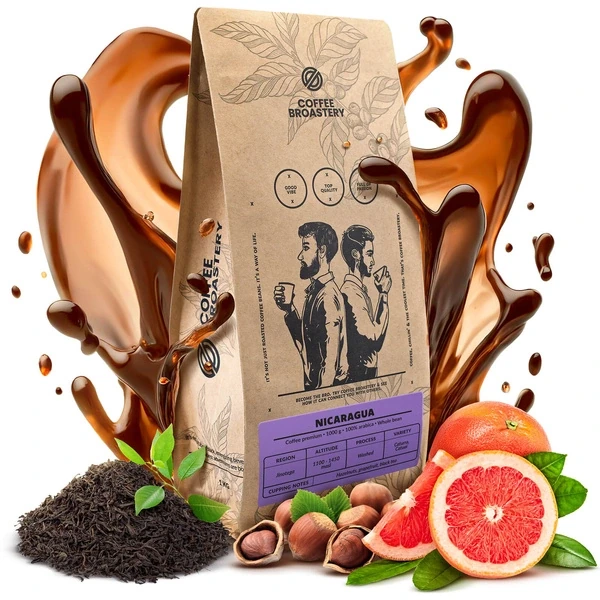
A light, smooth coffee with notes of hazelnuts, grapefruit and black tea. It tastes especially good from a dripper or a Chemex, and in an AeroPress it shows its nutty sweetness.
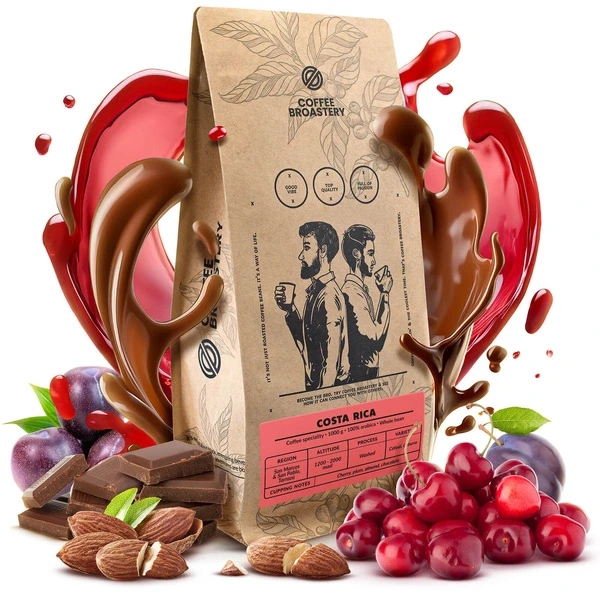
A coffee from the Tarrazú region with notes of cherry, plum, almonds and chocolate and a creamy body. A chocolate and cherry espresso and a juicy pour-over.
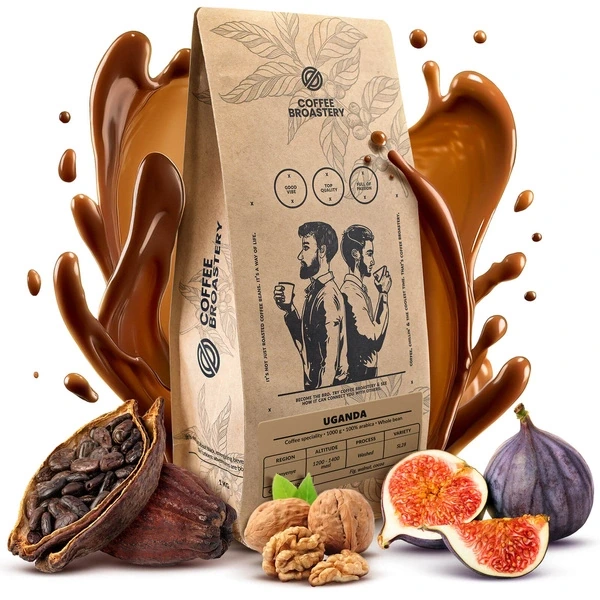
A coffee from the SL28 variety with notes of fig, walnut and cocoa. A cocoa-rich espresso, a full brew from a moka pot and a clean cup from a dripper.
Besides coffee beans, the brand's range also includes gift sets and a mix for making Pumpkin Spice Latte. You will find all the brand's products on the Bro Coffee Roastery at MateMundo page.
Bro Coffee Roastery artisan coffee for different brewing methods
Every artisan coffee from Bro Coffee Roastery comes with a description suggesting the brewing methods it works best in. Below, we have gathered these recommendations in one place to make it easier for you to match the beans to the equipment you use every day. Remember that these are guidelines, not strict rules – many coffees taste good with several methods.
Which Bro Coffee Roastery coffee for which brewing method?
| Brewing method | Recommended coffees | What to expect? |
|---|---|---|
| Espresso machine and bean-to-cup machine | Amico dall'Italia, Brazil Samba, Brazil Cerrado, Costa Rica San Rafael, India Karnataka | thick crema, full body, chocolate notes – also as a base for milk-based coffees |
| Moka pot | Brazil Cerrado, Brazil Guaxupe, Amico dall'Italia, Uganda Kanyenye, India Karnataka | a strong, rich brew with clear chocolate and nut notes |
| French press | Brazil Samba, Brazil Cerrado, Costa Rica San Rafael, Nicaragua Colibrí Azul, India Karnataka | a full or mild brew with a sweet aftertaste |
| AeroPress | Colombia Medellín, Brazil Guaxupe, Kenya Nyeri, Uganda Kanyenye | a balanced, smooth cup that combines sweetness with fruity notes |
| Dripper, V60, Chemex and filter coffee machine | Kenya Nyeri, Nicaragua Colibrí Azul, Guatemala Peña Roja, Colombia Medellín, India Karnataka | a light, clean brew in which subtle flavours are easy to taste |
If you brew coffee in different ways or are still putting your equipment together, the safest choice is Brazil Samba – its versatile roast works practically everywhere. For a home espresso machine and milk-based coffees, we particularly recommend Amico dall'Italia Espresso Roast, and for pour-over methods, coffees from the Speciality line from Kenya, Nicaragua or Guatemala. Whatever you choose, remember to match the grind size to the method: grind coffee finest for espresso, slightly coarser for a moka pot and an AeroPress, medium for a dripper and coarsest for a French press.
How should I store Bro Coffee Roastery coffee?
Even the best roastery coffee will quickly lose its aroma if it is stored badly. Fortunately, a few simple rules are enough to keep Bro Coffee Roastery beans fresh until the last serving:
- ✔️ keep the coffee in its original packaging – Bro Coffee Roastery doypacks have a one-way valve, a zip closure and a layer that protects against air and light, so there is no need to transfer the beans to other containers, such as glass jars,
- ✔️ seal the bag tightly after each use and press out as much air as possible,
- ✔️ choose a dry, shaded place at room temperature, away from the hob, the oven and a sunny windowsill,
- ✔️ do not store coffee in the fridge – changes in temperature encourage moisture to condense, and the beans easily absorb other smells,
- ✔️ grind the coffee just before brewing – ground coffee loses its aroma much faster than whole beans,
- ✔️ buy as much as you will use within a few weeks – that way the beans will keep their aroma until the last serving.
💡 Fun fact: Scientists observed for up to a year how whole coffee beans lose their freshness in different types of packaging. The results showed a clear link between how well the packaging material protects against external factors and how quickly the coffee loses its freshness. Materials with an aluminium layer performed best. This is why the quality of the packaging and sealing it tightly matter so much.
💬 Scientific source: A. N. Glöss et al., Freshness Indices of Roasted Coffee: Monitoring the Loss of Freshness for Single Serve Capsules and Roasted Whole Beans in Different Packaging, CHIMIA, 2014.
That, in short, is the world of artisan coffee. You now know that it is not a formal category, but an approach in which every stage matters – from growing and harvesting, through processing, sorting and roasting, to packing and storage. You also know how to read the information on the bag, what affects the flavour of coffee and how coffee from a roastery differs from supermarket coffee. Now the best thing to do is to test it in practice: choose a Bro Coffee Roastery coffee that suits your brewing method, brew it at least a week after the roast date and discover how many flavours a single cup can hold.
Freshly roasted coffee from an artisan roastery is waiting for you – find your favourite flavour!
❓ FAQ – frequently asked questions about Bro Coffee Roastery artisan coffee
1. What is artisan coffee?
2. What is craft coffee?
3. How is artisan coffee different from mass-produced coffee?
4. Is artisan coffee always freshly roasted?
5. How do I choose good coffee beans from a roastery?
6. Where can I buy Bro Coffee Roastery coffee?
7. Which Bro Coffee Roastery coffees are available at MateMundo?
8. How should I store Bro Coffee Roastery coffee beans?
Sources of information:
- Specialty Coffee Association: What Is Specialty Coffee?.
- Specialty Coffee Association: Coffee Decoded: What is “fresh” coffee?.
- A. M. Obando and J. G. Figueroa, Effect of Roasting Level on the Development of Key Aroma-Active Compounds in Coffee, Molecules, 2024.
- X. Shen et al., Effects of Different Primary Processing Methods on the Flavor of Coffea arabica Beans by Metabolomics, Fermentation, 2023.
- P. Zakidou et al., Single Origin Coffee Aroma: From Optimized Flavor Protocols and Coffee Customization to Instrumental Volatile Characterization and Chemometrics, Molecules, 2021.
- M. Worku et al., Effect of altitude on biochemical composition and quality of green arabica coffee beans can be affected by shade and postharvest processing method, Food Research International, 2018.
- S. Smrke et al., Time-Resolved Gravimetric Method To Assess Degassing of Roasted Coffee, Journal of Agricultural and Food Chemistry, 2018.
- A. N. Glöss et al., Freshness Indices of Roasted Coffee: Monitoring the Loss of Freshness for Single Serve Capsules and Roasted Whole Beans in Different Packaging, CHIMIA, 2014.
- R. D. C. C. Bandeira et al., Composição volátil dos defeitos intrínsecos do café por CG/EM-headspace, Química Nova, 2009.
Recommended

Bro Coffee Roastery – Whole Bean Coffee Brazil Cerrado Premium 1kg

Bro Coffee Roastery – Whole Bean Coffee Brazil Samba Premium 1kg

Bro Coffee Roastery – Whole Bean Coffee Colombia Medellin Premium 1kg
