
Is dried fruit healthy? Properties, calories and how to eat it wisely
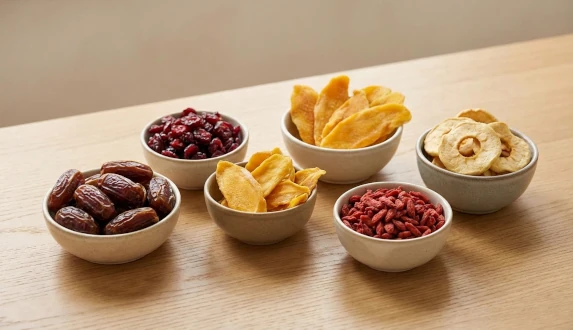
A quick snack, something sweet, an addition to tea, yerba mate or porridge – dried fruit has held a permanent place in the kitchens of people who want to eat more consciously for years. We reach for it on the go, add it to breakfasts and desserts, and sometimes treat it as a healthier alternative to sweets. Its small size and intense flavour make it easy to forget just how “concentrated” it really is. No wonder that with growing popularity comes a key question: is dried fruit healthy, or is it simply a clever “sweet trap”?
In today’s article, we take a closer look at this topic. We explain what dried fruit actually is, how the drying process works, how its properties and calorie content change, and how to include it in your diet in a sensible way. No demonising and no excessive idealising – just common sense.
Summary:
- Dried fruit – what it is and how it is made
- Is dried fruit healthy?
- Dried fruit – properties
- Dried fruit – nutritional value and calories
- The healthiest dried fruit – which should you choose?
- How to store dried fruit to keep it fresh
- Is dried fruit a healthy snack and where to buy good quality products?
Dried fruit – what it is and how it is made
Dried fruit is fruit from which most of the water has been removed during the drying process. It sounds simple – and in principle, it is. The key lies in the details, however, because the way water is removed has a huge impact on what properties dried fruit will have, as well as on its flavour, texture and nutritional value.
During drying, the volume of the fruit is significantly reduced, while what remains inside becomes naturally concentrated. This applies both to sugars naturally present in fruit, as well as to fibre, minerals and bioactive compounds such as polyphenols and antioxidants. That is why dried fruit calories are higher than in fresh fruit – yet at the same time, dried fruit can be described as “nutrition in a nutshell”.
At this point, it is worth debunking one of the most common myths. The intense sweetness of dried fruit does not necessarily mean added sugar. High‑quality sugar free dried fruit owes its flavour solely to nature and the drying process itself. Products such as dried goji berries, dried cranberries or dried dates can be found in our shop in the “Fruit” category – alongside candied and freeze‑dried fruit.
💡 Good to know: Removing water from fruit is one of the oldest methods of food preservation. Thanks to this, fruit not only lasts longer but also becomes a convenient snack that does not require refrigeration.
The result? Products that work perfectly as healthy snacks, additions to muesli, yoghurt, baked goods or infusions. The key factor, however, is the quality of the raw material and the drying method – because these determine whether dried fruit is genuinely beneficial or simply treated as a sweet extra.
Drying methods and their impact on fruit quality and nutritional value
Not all dried fruit is created equal. Differences begin at the technological stage, as each drying method affects dried fruit and its nutritional value, colour, flavour and texture in a different way.
- ✔️ Natural drying – involves slow evaporation of water in the sun or in well‑ventilated conditions. This is the most traditional method, but also the least predictable. Some vitamins (especially vitamin C) may degrade, although fibre and minerals largely remain intact.
- ✔️ Industrial drying (using hot air) – most commonly used on a larger scale. It produces a stable product of consistent quality, although higher temperatures may reduce the content of certain heat‑sensitive vitamins.
- ✔️ Freeze‑drying – drying using low temperatures. This method best preserves natural flavour, colour and bioactive compounds. Freeze‑dried fruit is light, crunchy and extremely rich in nutrients, although it is usually more expensive. We will write more about freeze‑drying on our blog soon.
Scientific research shows that modern drying technologies – including vacuum and hybrid drying – help preserve high antioxidant activity in fruit and limit the loss of vitamins and polyphenols. This is good news for anyone wondering is dried fruit healthy and whether it is worth including it in everyday meals.
💬 Scientific source: M. Radojčin et al., Effect of Selected Drying Methods and Emerging Drying Intensification Technologies on the Quality of Dried Fruit: A Review, Processes, 2021.
That is why when choosing products such as dried mango, dried chokeberry, dried rosehip or dried rowan berries, it is worth paying attention not only to flavour but also to ingredients and processing methods. These details determine whether dried fruit truly supports a balanced diet – especially when considering which dried fruit works best for weight management.
📌 In short:
- Drying concentrates nutrients and natural sugars.
- The drying method has a real impact on product quality.
- High‑quality sugar free dried fruit can be a valuable part of a healthy diet.

In the next section, we will take a closer look at when dried fruit supports health and when moderation is key – as well as which options are considered the healthiest dried fruit.
Is dried fruit healthy?
The short answer is: yes, dried fruit can be part of a healthy diet – but only under certain conditions. Both quality and the amount consumed on a daily basis play a key role. Drying turns fruit into a more concentrated source of energy and nutrients, but at the same time makes it much easier to eat too much compared to fresh fruit.
From a nutritional perspective, dried fruit owes its properties primarily to its high content of fibre, minerals and bioactive compounds such as polyphenols and antioxidants. Reviews of scientific studies show that regular, moderate consumption of dried fruit may positively affect overall diet quality – for example by increasing fibre intake and providing antioxidant compounds.
On the other hand, it cannot be ignored that dried fruit contains more calories than its fresh counterpart, and that naturally occurring sugars are highly concentrated. This is exactly why dried fruit often raises doubts and leads to questions such as: dried fruit – healthy or full of sugar?
📌 Let’s summarise:
- Dried fruit can support diet quality thanks to its concentrated nutritional value.
- It is more calorie‑dense than fresh fruit, so portion size matters.
- It is best treated as an addition or snack, not the foundation of a diet.
Dried fruit – healthy or full of sugar?
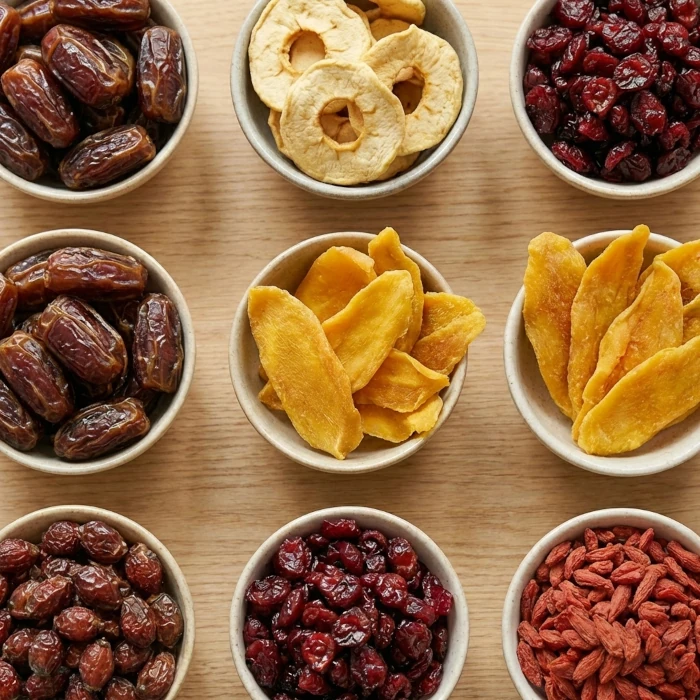
The high sugar content in dried fruit does not appear by accident. It is the result of a simple process: as water is removed, naturally occurring sugars become concentrated. In practice, this means that a handful of dried dates or dried cranberries delivers significantly more sugars than the same volume of fresh fruit.
However, it is important to clearly distinguish between natural sugar, which occurs in fruit alongside fibre and micronutrients, and added sugar. High‑quality sugar free dried fruit contains no sweeteners or syrups – its sweetness comes solely from the fruit itself. The idea of dried fruit as a “sweet trap” usually applies to candied fruit or products with added sucrose or glucose‑fructose syrup.
This is why dried fruit is sometimes seen as unhealthy – it is sweet, calorie‑dense and easy to overeat. At the same time, studies show that the fibre present in dried fruit may slow down sugar absorption, which clearly distinguishes it from typical sweets that offer calories without nutritional value.
💬 Scientific source: C. Alasalvar et al., Dried Fruits: Bioactives, Effects on Gut Microbiota, and Possible Health Benefits – An Update, Nutrients, 2023.
The authors point out that dried fruit provides fibre and bioactive compounds that may influence carbohydrate metabolism and overall diet quality, although clinical evidence regarding glycaemic control remains mixed.
When does dried fruit support health – and when can it be problematic?
Dried fruit works best as part of a well‑balanced diet, particularly in certain situations. Due to its high energy density and mineral content, it is often recommended for physically active people, during periods of increased energy demand, or in diets low in fibre:
- ✔️ as a quick source of energy before or after physical activity,
- ✔️ as a way to diversify the diet when fresh fruit intake is low,
- ✔️ as an addition to meals that support fibre intake.
On the other hand, there are situations where greater caution is advised. People with insulin resistance, diabetes, or those following a calorie‑restricted diet should monitor both portion size and frequency of consumption. In such cases, dried fruit does not need to be eliminated, but should be treated as an occasional addition rather than a daily snack.
The same principle applies to dried fruit for children. It can be a valuable part of a child’s diet, provided it is high quality and served in reasonable amounts – ideally alongside other foods, rather than as a replacement for fresh fruit.
💡 Worth remembering: It is not the product itself that determines whether something is “healthy”, but the dietary context, portion size and frequency of consumption. This rule applies perfectly to dried fruit.
In the next section, we will take a closer look at the properties of dried fruit that result from the concentration of nutrients and what exactly is hidden inside these small, flavour‑packed pieces.
Dried fruit – properties
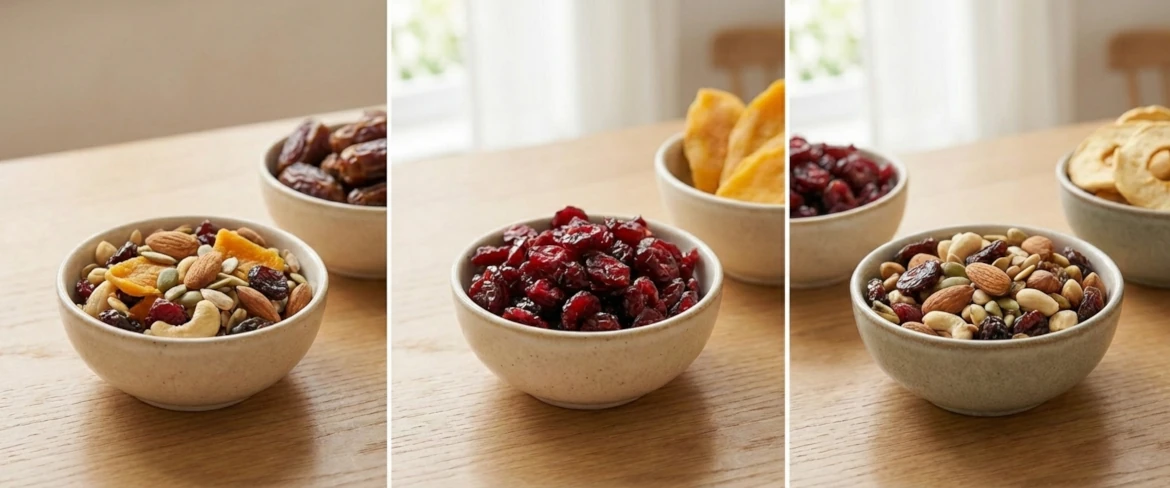
One of the main reasons why dried fruit continues to be popular among people who care about their diet is its concentrated properties resulting from the drying process. Removing water means that a relatively small portion of fruit contains nutrients that would otherwise be spread across a much larger volume in fresh fruit.
This is why dried fruit is often described as “nutrient‑dense”. It provides fibre, minerals and natural bioactive compounds that can complement everyday meals – as long as it is consumed in moderation and in the right dietary context. Below, we take a closer look at the key groups of components responsible for the properties of dried fruit.
Fibre, vitamins and minerals in dried fruit
Dietary fibre is one of the most important components found in dried fruit. The drying process does not remove fibre; on the contrary, it becomes more concentrated in a smaller serving. Thanks to this, dried fruit can be a practical way to supplement fibre intake, especially when consumption of fresh fruit and vegetables is insufficient.
In addition to fibre, the dried fruit nutritional value comes from the presence of minerals such as potassium, magnesium and iron, and in some cases also vitamins. Their levels depend on the type of fruit and the drying method used – more advanced technologies help preserve a greater proportion of sensitive nutrients.
Dried fruit typically contains:
- ✔️ fibre – supports proper digestion and helps maintain satiety,
- ✔️ potassium and magnesium – important for electrolyte balance and muscle function,
- ✔️ iron – present, for example, in dried dates and dried chokeberry, as part of a varied diet.
This combination is why dried fruit is often recommended for physically active individuals and for those looking to enrich everyday meals – such as porridge, yoghurt or herbal infusions – in a simple and convenient way.
Antioxidants and their role in dried fruit
Antioxidants are a group of bioactive compounds that include polyphenols, flavonoids and anthocyanins. They occur naturally in fruit and, thanks to drying, may be present in a more concentrated form. For this reason, dried fruit is often regarded as a valuable source of antioxidants in the diet.
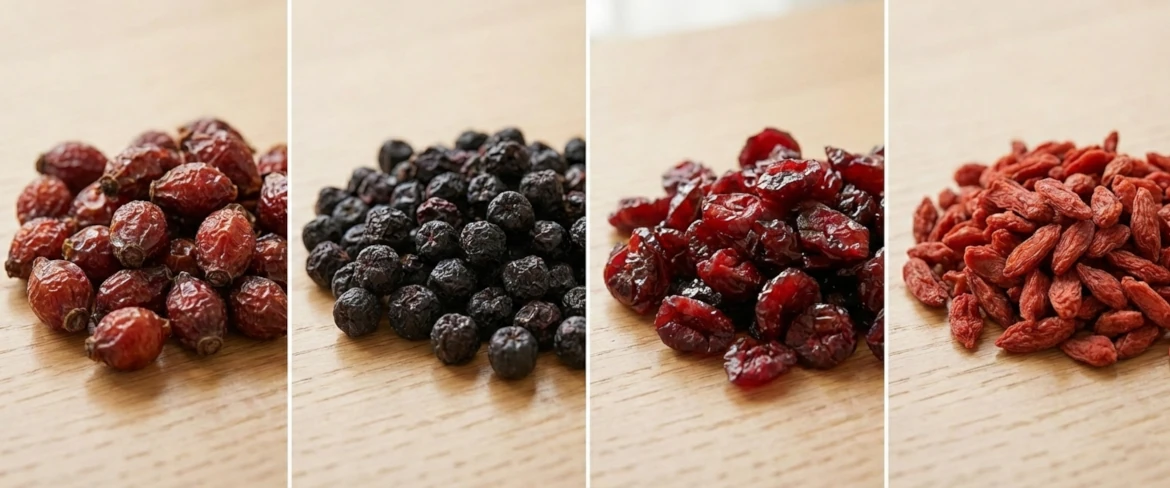
Scientific reviews indicate that certain types of dried fruit – particularly those with deep, intense colours – stand out for their high antioxidant content. This applies, for example, to dried chokeberry, dried goji berries, dried cranberries and dried rosehip.
✨ Dried fruit with the highest antioxidant content
The highest levels of antioxidants are usually found in fruit with a dark, intense colour, which indicates the presence of polyphenols, flavonoids and anthocyanins. In dried form, the concentration of these compounds is higher than in fresh fruit.
- Dried rosehip – exceptionally rich in vitamin C and phenolic compounds, with very high antioxidant potential.
- Dried chokeberry – one of the richest natural sources of anthocyanins, often considered a leader among berry fruits.
- Dried goji berries – valued for their carotenoid and polyphenol content, popular in Asian cuisine.
- Dried cranberries – a source of phenols and proanthocyanidins; best chosen in sugar‑free versions.
- Dried blueberries and wild berries – retain high antioxidant levels, especially when gently dried.
Worth remembering: a high antioxidant content does not mean that one product “does it all”. The best results come from variety and regularly choosing different types of dried fruit.
In practice, this means that dried fruit can be an excellent complement to an antioxidant‑rich diet, but the greatest benefits are seen when it forms part of a varied eating pattern rather than being treated as the sole or “therapeutic” source of these compounds.
Dried fruit, digestion and immune support
The impact of dried fruit on the body is most often discussed in the context of the digestive system. A key role is played by fibre, which supports normal bowel movements and contributes to a diverse gut microbiota.
Some studies suggest that regular consumption of dried fruit may be associated with better overall diet quality and beneficial changes in gut microbiota composition. At the same time, researchers emphasise that clinical evidence is still limited and depends on the type of fruit and the overall dietary pattern (Source: previously cited review by C. Alasalvar et al., Nutrients, 2023).
From a practical perspective, dried fruit works best as:
- ✔️ part of a diet supporting digestion thanks to its fibre content,
- ✔️ a way to diversify meals during periods of increased energy demand,
- ✔️ an addition to meals, rather than a stand‑alone “solution” for immunity.
As in previous sections, moderation and product quality are crucial. These factors determine whether dried fruit genuinely supports a balanced diet.
In the next section, we will focus on concrete figures – examining dried fruit calories and nutritional values, and how to plan portions in order to enjoy the benefits without excess.
Dried fruit – nutritional value and calories
After discussing the properties of dried fruit, it is time to focus on concrete figures. In this section, we look at the dried fruit nutritional value, calorie content and its impact on blood sugar levels. Numbers best explain why dried fruit can be both a valuable dietary element and a product that requires a mindful approach.
Compared to fresh fruit, dried fruit is a more concentrated source of energy. It contains less water and more natural sugars, fibre and minerals per 100 g. For this reason, when planning portions, it is worth considering not only the ingredients but also the quantity.
Why is dried fruit high in calories?
The main reason why dried fruit calories are relatively high is the removal of water during the drying process. Water does not provide calories, but it makes up a large part of the weight of fresh fruit. Once it is removed, the same volume contains a much higher concentration of sugars and other energy‑providing components.
For comparison, eating 100 g of fresh grapes requires a large bunch. Meanwhile, 100 g of raisins fits easily in a small handful – and the calorie difference is significant. The same applies to products such as dried dates, dried mango or dried cranberries.
- 👉 Fresh fruit – high water content, lower energy density,
- 👉 Dried fruit – low water content, high concentration of calories and natural sugars.
This is why dried fruit is not “unhealthy in itself”, but it is easy to eat too much. The key is to treat it as an addition or controlled portion, rather than a snack eaten without thought.
💡 Worth remembering: A small portion of dried fruit can provide the same amount of energy as a much larger portion of fresh fruit.
Nutritional value of dried fruit and its glycaemic index
Dried fruit nutritional value comes primarily from carbohydrates (mainly natural sugars), fibre and minerals. Protein and fat content is usually low, which is why dried fruit works best as part of a larger meal rather than as a stand‑alone dish.
When it comes to blood sugar levels, questions often arise about the glycaemic index of dried fruit. It is worth remembering that GI depends not only on the product itself, but also on portion size and what it is eaten with.
- ✔️ Fibre‑rich fruits (such as dried chokeberry or dried rosehip) tend to have a lower glycaemic impact.
- ✔️ Very sweet fruits (such as dried dates) may raise blood glucose levels more quickly.
- ✔️ Combining dried fruit with protein or fat (for example yoghurt or nuts) helps slow sugar absorption.
For this reason, people with insulin resistance or those aiming to maintain stable energy levels should pay attention not only to which dried fruit they choose, but also to how it is combined on the plate.
So which products can be considered the healthiest dried fruit, and what should you look for when choosing them? You will find out in the next section.
The healthiest dried fruit – which should you choose?
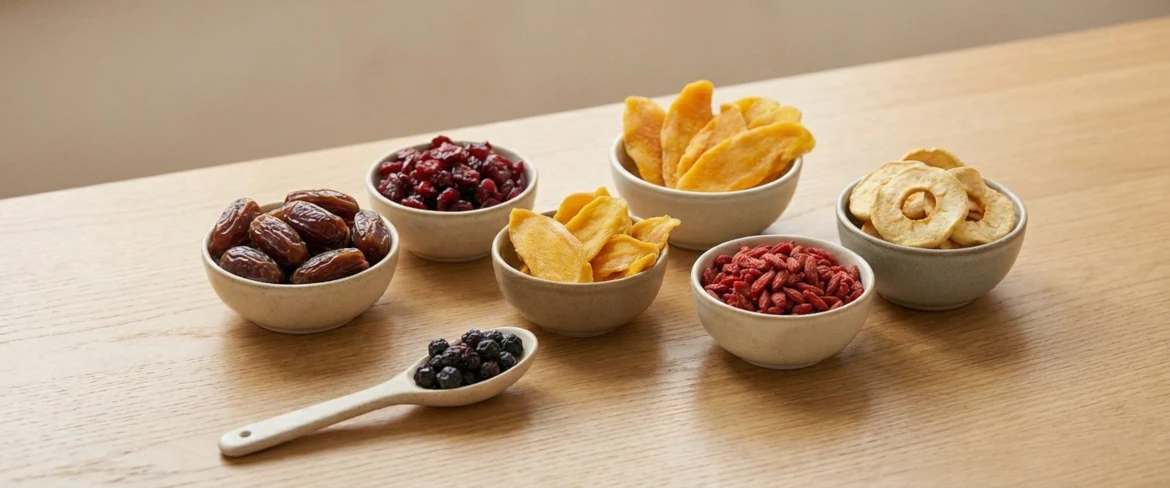
There is no single universal list of “perfect” products, but some dried fruit stands out for its particularly beneficial nutritional profile. Rich in fibre, natural bioactive compounds and minerals, it can be a valuable part of an everyday diet when eaten in sensible portions. Below is a selection of products often described as the healthiest dried fruit.
Dried dates – properties and nutritional value
Dried dates are a concentrated source of nutrients: energy, fibre and minerals such as potassium and magnesium. They work well as a quick snack for physically active people and as a natural alternative to sugar in homemade desserts.
Due to their high natural sugar content, they should be eaten in moderation, especially when following a calorie‑controlled diet.
Dried goji berries – natural support for the body
Dried goji berries are valued for their antioxidant, vitamin and carotenoid content. Often referred to as a superfood, they work well as an addition to muesli, yoghurt or herbal infusions.
They are best treated as part of a varied diet rather than a single “miracle” ingredient.
Dried cranberries – are they healthy?
Dried cranberries are rich in phenolic compounds, but their health value depends largely on composition. Sweetened versions may contain significant amounts of added sugar.
It is best to choose sugar free dried fruit and treat dried cranberries as a meal addition rather than a sweet snack.
Dried chokeberry – a powerhouse of antioxidants
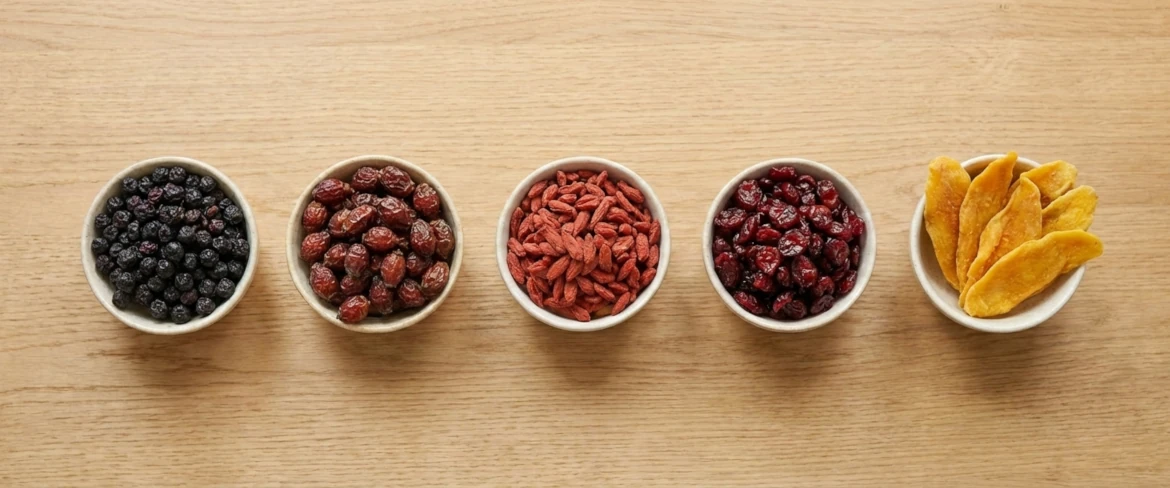
Dried chokeberry stands out for its exceptionally high antioxidant content, especially anthocyanins. With its intense, slightly tart flavour, it works perfectly as an addition to teas, infusions and fruit blends.
This is a great choice for those looking to enrich their diet with nutrient‑dense foods.
Dried rosehip and dried rowan – underrated superfoods
Dried rosehip and dried rowan berries are less common but highly interesting fruits in terms of nutritional value. Rosehip is known for its high vitamin C content, while rowan berries contain distinctive bioactive compounds.
They are most often used as ingredients in herbal teas and infusions.
Dried mango and coconut flakes – healthy snack or dessert?
Dried mango and coconut flakes delight with their flavour, but due to their calorie density they are best treated as an addition or dessert rather than a primary snack.
In sugar‑free or minimally sweetened versions, they can add variety to the diet – provided that portion size is controlled.
How to store dried fruit to keep it fresh
To ensure dried fruit retains its flavour, aroma and nutritional value for as long as possible, it is worth following a few simple rules on how to store dried fruit. Protection from moisture, air and light is essential.
- ✔️ Store dried fruit in airtight containers or resealable packaging, preferably glass or metal.
- ✔️ Choose a dry, cool and shaded place – excess heat and light accelerate quality loss.
- ✔️ Protect fruit from moisture, which promotes clumping and mould growth.
- ✔️ Always seal the packaging tightly after use to limit air exposure.
When stored correctly, dried fruit can maintain good quality for weeks or even months, making it a convenient and tasty addition to everyday meals.
Is dried fruit a healthy snack and where can you buy good quality products?
To summarise the entire article, the answer to the main question is clear: yes, dried fruit can be a healthy snack – provided you choose high‑quality products and eat them in moderation. Thanks to their concentrated nutrients, they work well as a quick energy boost, a meal addition or part of a balanced diet.
The best choice is sugar free dried fruit, without unnecessary additives and consumed in controlled portions. For many people, it is a sensible alternative to sweets – both on a daily basis and “in emergencies” while travelling or at work. It is therefore no surprise that specific questions arise, such as: are dried apples healthy? The answer is similar to other fruits – it depends on ingredients, drying method and portion size.
If you value conscious choices, it is worth buying dried fruit from trusted sources. In the MateMundo store you will find a wide selection of high‑quality products – including dried dates, dried cranberries, dried mango, dried chokeberry and dried goji berries – perfect for snacking and cooking alike.
Mindful choices, variety and moderation are the best recipe for making dried fruit genuinely support a healthy diet – without guilt and without “sweet traps”.
Eat mindfully, choose clean ingredients and discover the flavours of dried fruit on your own terms!
❓ FAQ – frequently asked questions about dried fruit
1. Is dried fruit healthy and can it be eaten every day?
2. How many calories does dried fruit have compared to fresh fruit?
3. Does dried fruit contain a lot of sugar?
4. How can you recognise good quality dried fruit?
5. Which dried fruit works best on a calorie‑controlled diet?
Sources of information:
- Wikipedia: Dried fruit.
- C. Alasalvar et al., Dried Fruits: Bioactives, Effects on Gut Microbiota, and Possible Health Benefits – An Update, Nutrients, 2023.
- M. Radojčin et al., Effect of Selected Drying Methods and Emerging Drying Intensification Technologies on the Quality of Dried Fruit: A Review, Processes, 2021.
- A. S. Shah et al., Processing Technology, Chemical Composition, Microbial Quality and Health Benefits of Dried Fruits, Current Research in Nutrition and Food Science, 2021.
- D. Donno et al., Traditional and Unconventional Dried Fruit Snacks as a Source of Health-Promoting Compounds, Antioxidants, 2019.
Recommended

Vivarini - Goji Berries (dried) 250g

Vivarini - Cranberries (dried) 1kg
