
Freeze-dried fruit – what does it mean, are freeze dried fruits healthy and how to eat them?
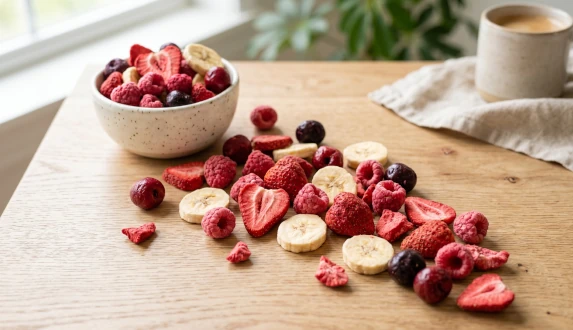
Crispy, intensely fruity and surprisingly light – freeze dried fruit is taking over the shelves of health food shops. It’s no surprise: it combines the convenience of a snack with a natural composition and a high content of nutrients. What’s more, thanks to its form, it is extremely practical – it does not require refrigeration, does not spoil quickly and is always ready to eat, regardless of the situation. This is why more and more people are reaching for it not only as a substitute for sweets, but also as part of a daily, well-balanced diet.
Freeze-dried fruit – what does it mean? Is it really worth including it in your diet? If you have been asking yourself these questions, you are in the right place! In this article, we explain what is freeze drying, how the process affects flavour, texture and nutritional value, and how freeze-dried fruit differs from traditional dried snacks. We will also show you how to use freeze-dried fruit in practice – from quick snacks and breakfast toppings to naturally enhancing drinks and desserts. What’s more, later in the article we will introduce a completely new brand available in our shop – FiloLilo freeze-dried fruit. Read on!
Table of contents:
- What is freeze dried fruit and what is freeze drying?
- Are freeze dried fruits healthy?
- Most popular freeze dried fruits – which ones to choose?
- New: FiloLilo freeze-dried fruit – a convenient everyday snack
- FiloLilo freeze-dried fruit – available flavours and varieties
- FiloLilo – when is it worth choosing a particular pack size?
- How to eat freeze dried fruit and how to use it?
- Freeze dried fruit for children – is it a good choice?
- Freeze dried fruit – where to buy and how to choose a good producer?
What is freeze dried fruit and what is freeze drying?
What is freeze dried fruit? Simply put, it is fruit that has had water removed in a very specific way – without using high temperatures. Thanks to this, it retains its natural flavour, colour and a large portion of its nutritional value. Importantly, this process does not expose the fruit to high temperatures, as is the case with traditional drying – which is why its structure and composition remain largely intact.
In practice, this means that freeze dried fruit is light, crispy and intensely flavoured – often even more so than its fresh counterpart. This is the result of removing almost all the water, which in fresh fruit can account for as much as 80-90% of its composition. What remains is what matters most: natural sugars, aromas and bioactive compounds.
In the fruit category available in our shop, freeze dried products are becoming increasingly popular – from classics such as freeze dried strawberries and freeze dried raspberries to more exotic options. Their growing popularity is no coincidence – this is a convenient form of fruit that works perfectly both as a quick snack and as an addition to everyday meals.
Compared to traditional food preservation methods, freeze drying stands out because it helps retain as much of what is most valuable in fruit as possible – without added sugar or preservatives. This is why freeze dried products are often chosen by people looking for simple, natural ingredients and greater control over what they eat.
Freeze drying fruit – what does it actually mean?
The term itself may sound quite technical, but in practice it is surprisingly simple. What is freeze drying? It is a process of drying by freezing, in which water is removed from the product through a phenomenon known as sublimation. The entire process takes place at low temperatures – which means the fruit is not exposed to heat that could damage its structure and valuable nutrients.
Freeze drying is considered one of the gentlest methods of food preservation. Unlike traditional drying, there is no intensive heat treatment – instead, the fruit retains its natural form almost unchanged.
Sounds complicated? It can be explained more simply:
- ➡️ the fruit is first frozen,
- ➡️ then placed in low-pressure conditions,
- ➡️ the ice turns directly into water vapour – skipping the liquid stage.
This stage – sublimation – is what prevents the fruit’s cells from collapsing as they do during traditional drying. Instead, microscopic empty spaces form where water used to be, giving freeze dried fruit its characteristic lightness and crunch.
The result? The fruit retains its shape, structure and aroma, while becoming light and crispy. What’s more, the flavour can be even more intense than in fresh fruit – because without water, the natural sweetness and aroma are no longer diluted. That is why freeze dried fruit is often described as “fresh fruit in a crunchy version”.
💡 Did you know? Freeze drying technology was not invented by NASA, but space programmes significantly contributed to its development and popularisation. Astronauts needed lightweight, durable and nutritious food – which is why freeze dried products became an important part of their diet. Over time, this technology made its way into everyday use on Earth.
💬 Source: Freeze-Dried Foods Nourish Adventurers and the Imagination, spinoff.nasa.gov, 2020.
How does the freeze drying process work and how is it different from drying?
Although both freeze drying and traditional drying aim to remove water, they differ in almost every aspect when it comes to the final result. The key difference lies in temperature and the way water is removed, which directly affects flavour, structure and nutritional value.
In traditional drying, fruit is exposed to high temperatures, which unfortunately impacts its structure and composition. High heat can lead to the loss of certain vitamins (especially vitamin C) as well as changes in flavour and colour. If you would like to learn more about this method, check out our article: Is dried fruit healthy? Properties, calories and how to eat it wisely.
Freeze drying fruit works differently and is a much more advanced process:
- Stage 1: rapid freezing of the fruit (even down to -50°C), which helps preserve its cellular structure,
- Stage 2: lowering the pressure in a special vacuum chamber,
- Stage 3: sublimation – removing water without turning it into liquid, meaning ice transitions directly into vapour.
Thanks to this process, the fruit does not lose its shape – it does not shrink or collapse as it does during traditional drying. What’s more, it retains its natural colour and aroma, as well as a large portion of its bioactive compounds, which is confirmed by studies cited in scientific literature.
💬 Scientific source: C. Ratti, Hot air and freeze-drying of high-value foods: a review, Journal of Food Engineering, 2001.
The most important differences between freeze drying and traditional drying:
⚖️ Freeze drying vs traditional drying – key differences
| Feature | Freeze drying | Traditional drying |
|---|---|---|
| Nutritional value | up to 95-98% preserved | significant losses (especially vitamin C) |
| Taste and aroma | natural, intense | altered, more processed |
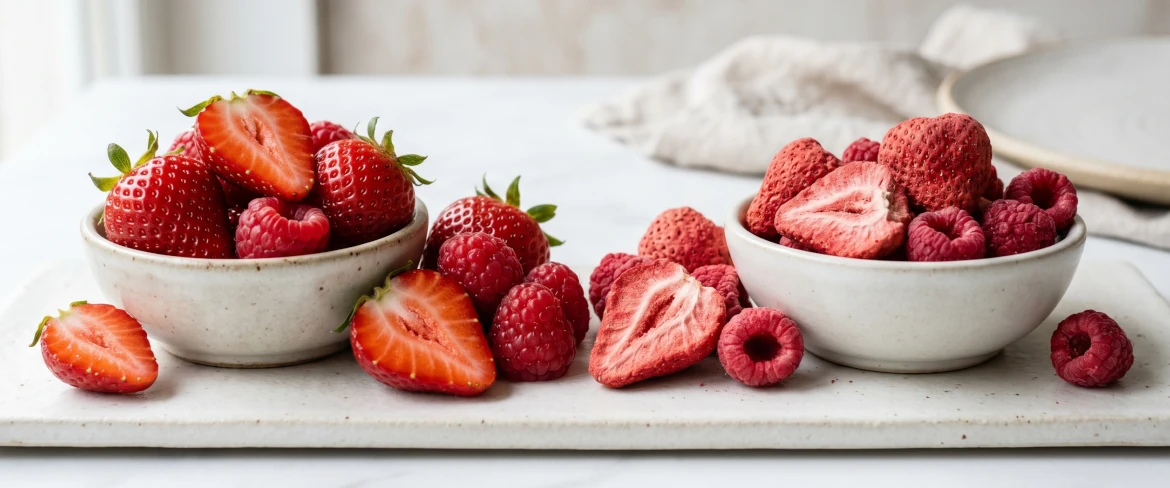
| Appearance | shape and colour preserved | shrunken, darker |
| Composition | 100% fruit, no additives | often includes additives (sugar, preservatives) |
| Texture | light, crispy | harder, denser |
As you can see, freeze drying fruit allows you to preserve what is most valuable – natural flavour, aroma, structure and a large portion of nutrients, without the need for high temperatures or additives. This is why freeze dried fruits (such as freeze dried bananas, freeze dried cherries or freeze dried raspberries) stand out compared to traditionally dried products.
As a result, they are not only a convenient and long-lasting snack, but also a versatile addition to many dishes and drinks – from porridge and desserts to naturally flavouring beverages such as yerba mate. This brings us back to one of the most frequently asked questions: are freeze dried fruits healthy and how do they fit into a daily diet? Let’s explore that in the next section.
Are freeze dried fruits healthy?
This is one of the most common questions asked about this type of product: are freeze dried fruits healthy? The short answer is yes – but, as with most foods, the key lies in portion size and the overall context of your diet.
Because freeze drying is carried out without high temperatures, it allows much of the nutritional value to be preserved. As a result, freeze dried fruit can be a valuable addition to your daily diet – especially when fresh fruit is not readily available or when you are looking for a convenient, natural snack.
However, it is worth remembering that although these are still fruits, their form is more concentrated – mainly due to the removal of water. This means they provide a significant amount of nutrients in a small volume, which is both an advantage and something to be mindful of when it comes to portion control.
Freeze dried fruit – nutrients and vitamins
Freeze dried fruit retains a large proportion of the vitamins, minerals and bioactive compounds found in fresh fruit. This includes vitamin C, polyphenols and antioxidants, which are particularly sensitive to high temperatures – something avoided in the freeze drying process. As a result, nutrient losses are significantly lower than with traditional drying methods.
💬 Scientific source: A. Michalska et al., Effect of different drying techniques on physical properties and antioxidant capacity of fruits, LWT – Food Science and Technology, 2017.
Moreover, removing water naturally concentrates the nutrients. This means that a smaller portion contains relatively more nutrients than the same volume of fresh fruit. That is why freeze dried products are often described as nutrient-dense foods – providing a high amount of beneficial compounds in a small serving.
This makes freeze dried fruit a valuable addition to a daily diet – particularly when you want a quick and convenient way to consume beneficial nutrients. In practice, reaching for freeze dried raspberries, freeze dried strawberries or freeze dried cherries means not only enjoying natural sweetness, but also a concentrated dose of plant-based compounds:
- ✔️ vitamins – such as vitamin C and some B vitamins,
- ✔️ minerals – including potassium and magnesium,
- ✔️ antioxidants – supporting the protection of cells against oxidative stress.
It is also worth noting that thanks to their structure, freeze dried fruits retain not only their composition but also an intense flavour and aroma – meaning even a small amount can significantly enhance a meal. This is especially useful for breakfasts, desserts or drinks, where both taste and nutritional value matter.
Importantly, in most cases these are single-ingredient products – with no added sugar, colourings or preservatives. This is a major advantage for those who value simple, “clean label” ingredients.
🧐 Worth knowing: Because the water has been removed, freeze dried fruits are very light but also “concentrated”. This means a small portion can correspond to a much larger amount of fresh fruit.
Freeze dried fruit – how many calories do they have and are they diet-friendly?
If you are wondering how many calories freeze dried fruit contains, the answer is: more per 100 g than fresh fruit – but not because they are “heavier”, rather because the water has been removed. In the same weight, there is simply more “pure fruit”, and therefore more natural sugars and energy.
However, it is worth looking at this from another perspective – freeze dried fruit is very light, so it is rarely consumed in quantities equivalent to 100 g. In everyday use, it is usually just a few grams as an addition to a meal, which means its caloric impact is not as high as it might seem. For example, a handful of freeze dried strawberries can correspond to several handfuls of fresh fruit. Calories and natural sugars are therefore more concentrated – which is why it is easy to eat more than you realise.
Does that mean they are not diet-friendly? Not necessarily. Freeze dried fruit can be part of a healthy diet, including a weight-loss diet – as long as you are mindful of portion sizes:
- ✔️ they work well as a substitute for sweets,
- ✔️ they complement oatmeal, yoghurt and smoothies, adding flavour without extra sugar,
- ✔️ they can be included in a calorie-controlled diet – provided portion sizes are managed,
- ✔️ their intense flavour means you can use smaller amounts while still achieving a strong taste effect.
It is best to treat them as a valuable addition rather than an unlimited snack. They work particularly well as a way to enhance meals – adding both flavour and nutrients without the risk of overconsumption.
📌 In short:
Around 10 g of freeze dried fruit can correspond to as much as 80-100 g of fresh fruit. This shows how easy it is to unintentionally increase your portion – so it is worth consuming them in moderation.
Most popular freeze dried fruits – which ones to choose?
Now that you know what freeze-dried fruit is and how it works, the next question is: which types should you choose? The market offers an increasingly wide range – from classic berry flavours to more exotic options. Each of them has a slightly different taste profile and use, so it’s worth matching them to your preferences and intended use.
🍓 Most popular freeze dried fruits
The selection of freeze dried fruit is truly wide – from sweet and delicate to bold and slightly tangy. Each works best in different applications, so it’s worth knowing their characteristics:
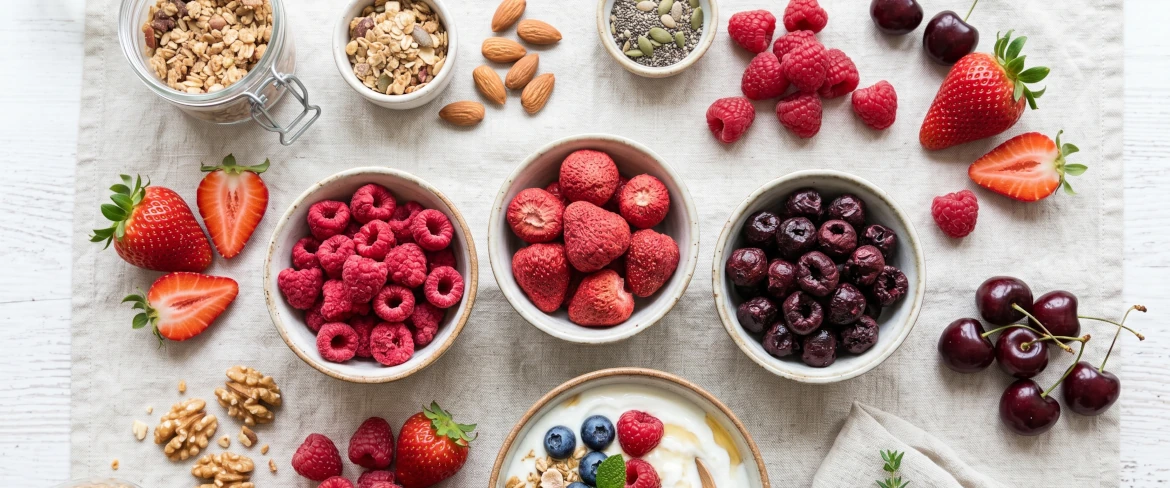
- 🍓 freeze dried strawberries – sweet, slightly tangy, perfect for breakfast and desserts,
- 💗 freeze dried raspberries – more intense and tart, ideal for yoghurt and baking,
- 🍌 freeze dried bananas – mild, naturally sweet, great as a snack,
- 🍒 freeze dried cherries – bold, slightly tart, excellent for drinks and desserts.
Each of these fruits retains its distinctive flavour, but in a more concentrated form – so even a small amount can make a noticeable difference to the taste of a dish. It is worth remembering, however, that alongside classic whole fruits, slices and pieces, other forms are also becoming increasingly popular, such as finely ground powder.
Freeze dried fruit powder – uses and benefits
More and more often, you will come across freeze dried fruit powder. It is simply finely ground fruit that retains its properties while gaining completely new possibilities of use. Thanks to this, it combines the advantages of classic freeze dried fruit with even greater convenience of use.
This form is exceptionally practical – it is easy to store, measure and combine with other ingredients. Importantly, it is still 100% fruit, with no additives, just in a more versatile form. That is why this form is widely used both in home cooking and in the food industry.
Its greatest advantage is versatility – it works well in many different applications:
- ✔️ ideal for smoothies and shakes, where it dissolves easily and adds intense flavour,
- ✔️ excellent as an addition to yoghurt, porridge and desserts, without changing their texture,
- ✔️ can be used as a natural colouring and flavouring in baked goods, creams or toppings,
- ✔️ also works well in more functional products, such as dietary supplements or protein blends.
It is also worth noting that freeze dried fruit powder is increasingly appearing not only in the kitchen, but also in various drinks and functional blends. A good example is products based on dragon fruit, which stand out for their intense colour and delicate fruity flavour. In this form, they work perfectly as a way to enhance everyday drinks – not only in terms of taste, but also visually.
Unlike fruit pieces, the powder does not change the structure of a dish – it does not add crunch or absorb moisture, but blends evenly with it. This gives you greater control over the final result, which is especially appreciated by those who enjoy experimenting in the kitchen.
Thanks to its intense flavour and colour, even a small amount of powder can completely transform the character of a dish. It is a great option for those looking for convenient, versatile and simple-ingredient solutions – both for everyday use and more creative applications.
New: FiloLilo freeze-dried fruit – a convenient everyday snack
In response to the growing popularity of healthy, natural snacks, we are proud to introduce a completely new addition to our range. FiloLilo freeze-dried fruit is a choice that proves a balanced diet and good eating habits do not have to be boring!
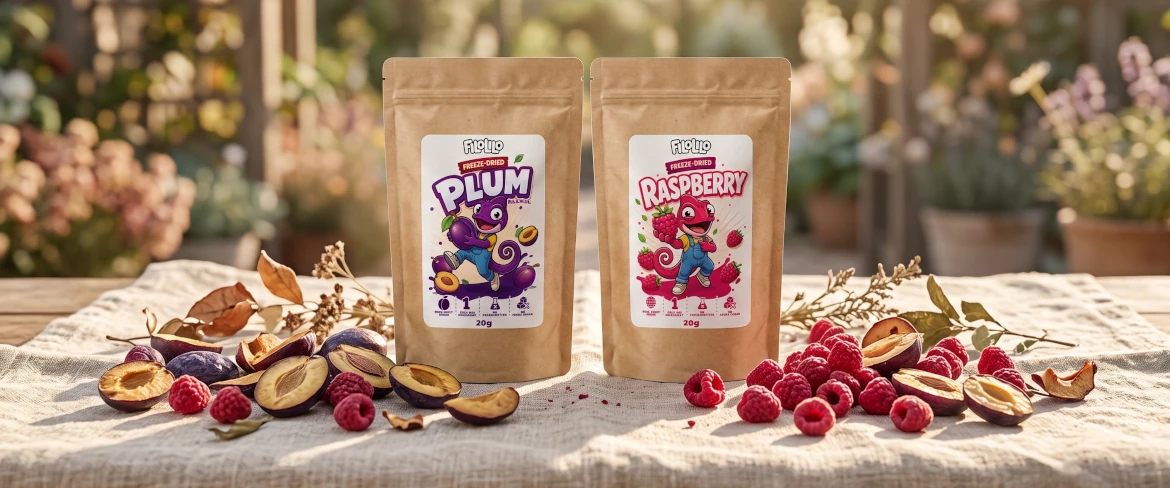
The FiloLilo brand was created for people looking for high-quality products without compromise. Whether you are a busy adult who needs a quick source of energy or a parent looking for a suitable snack for your child, this brand is a practical answer to everyday needs. FiloLilo’s recognisable symbol is a colourful chameleon – and that is no coincidence! Like this agile animal, FiloLilo’s natural snacks easily adapt to your busy lifestyle, bringing a different colour and flavour to each day.
What makes FiloLilo freeze-dried fruit stand out?
Above all, it is the quality and uncompromising approach to ingredients. During production, we seal the best of nature into every pack, paying meticulous attention to every detail. Years of experience and our own production line give FiloLilo, as a freeze-dried fruit producer, full control over the freeze-drying process. This directly contributes to the fruit’s nutrient density, intense aroma and distinctive crispness.
🦎 FiloLilo – 100% fruit, 100% character
Why choose the FiloLilo brand? Here are some of its key advantages:
- ✔️ simple ingredients and a clean profile – the pack contains fruit only. The brand guarantees no preservatives or artificial colourings;
- ✔️ no added sugar – natural sweetness straight from the fruit, with no unnecessary flavour enhancers;
- ✔️ deliciously crisp texture – thanks to an innovative low-temperature drying method, the fruit is exceptionally crunchy and full of intense flavour;
- ✔️ maximum convenience – practical doypacks with a zip fastening make it easy to take your snack with you and protect the product from moisture, helping it stay fresh after every opening.
Different forms and pack sizes of freeze-dried fruit
To make it easy to fit your snack around your plans, FiloLilo freeze-dried fruit is available in different forms. Depending on the type of fruit, the packs may contain whole pieces (for example, strawberries or pitted cherries), as well as convenient halves or easy-to-use slices (ideal for plums and bananas). This variety of forms not only makes the fruit enjoyable to eat straight from the pack, but also makes it easier to use for decorating desserts or adding to your morning porridge.
The brand also offers different pack sizes. At present, you can choose between two main options: smaller, handy 20 g packs and larger, more economical 100 g packs. Both versions offer plenty of room for culinary creativity – and more besides. When is it best to choose each size, and which situations are they most suitable for? We will explain this in more detail shortly!
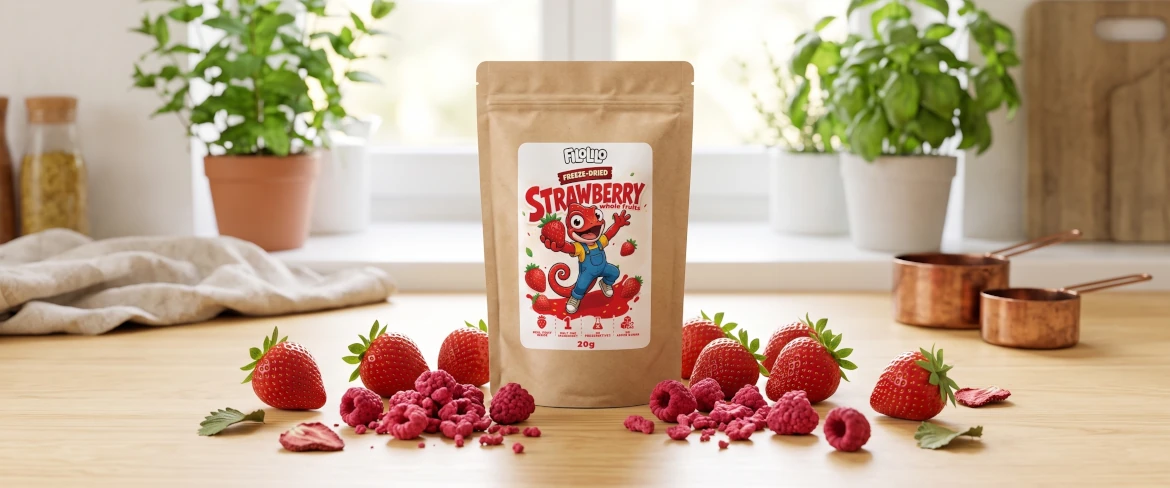
FiloLilo freeze-dried fruit – available flavours and varieties
The FiloLilo range has been designed to meet a variety of culinary needs. It includes fruit with different flavour profiles – from very sweet to slightly tart and more intense. The fruit is available in forms that make it easy to enjoy every day and add to meals. Explore the available varieties and choose the ones that best suit your diet.
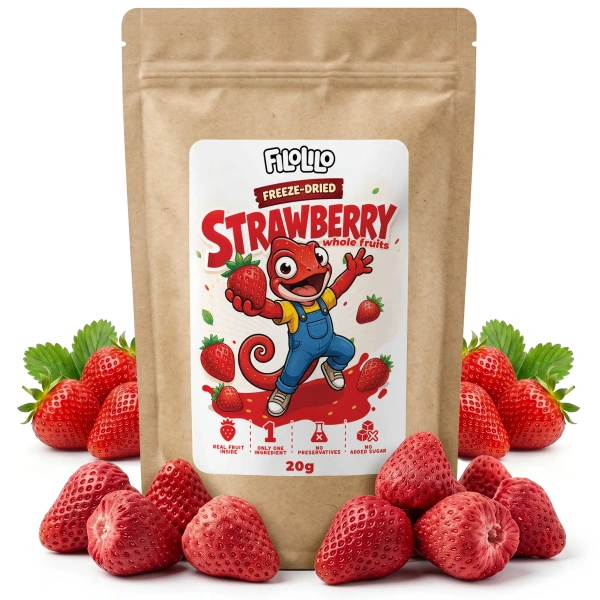
🍓 FiloLilo freeze-dried strawberries (whole and sliced)
Freeze-dried strawberries are a true classic and one of the most popular fruit choices. They offer a perfect balance of natural sweetness and gentle, refreshing acidity. To make them as versatile as possible, FiloLilo offers them in two forms:
- whole fruit – an excellent choice for a quick, crunchy snack straight from the pack (see: FiloLilo whole freeze-dried strawberries 20 g),
- convenient slices – ideal as an attractive addition to porridge, muesli, yoghurt or homemade baked goods (see: FiloLilo sliced freeze-dried strawberries 20 g).
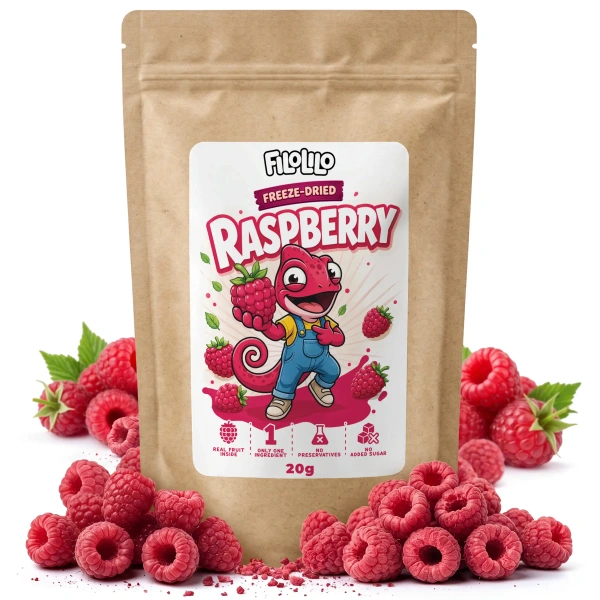
❤️ FiloLilo freeze-dried raspberries
Intense, expressive and pleasantly tart – freeze-dried raspberries are a great choice for anyone looking for a more pronounced flavour. Their natural profile perfectly balances the sweetness of creamy desserts, smoothies and sweet breakfasts. Due to their delicate texture, FiloLilo raspberries are available as whole fruits as well as smaller pieces, making them easy to add directly to dishes without having to crush them first.
See the product: FiloLilo freeze-dried raspberries 20 g
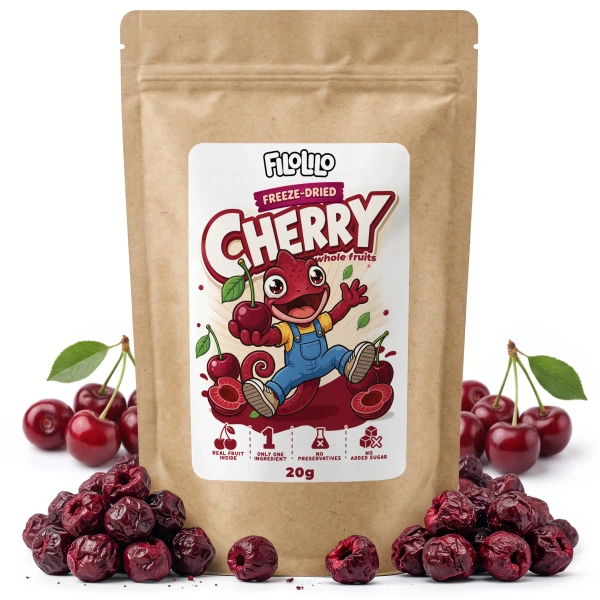
🍒 FiloLilo freeze-dried cherries (whole and pitted)
Freeze-dried cherries offer a deep, distinctive flavour in an exceptionally convenient form. To make them as easy and comfortable to eat as possible, FiloLilo cherries are carefully pitted – with no stones, you can enjoy them on the go or serve them to younger children with confidence. Their slightly tart flavour pairs perfectly with dark chocolate and also makes a delicious addition to infusions such as your favourite tea or yerba mate.
See the product: FiloLilo whole pitted freeze-dried cherries 20 g
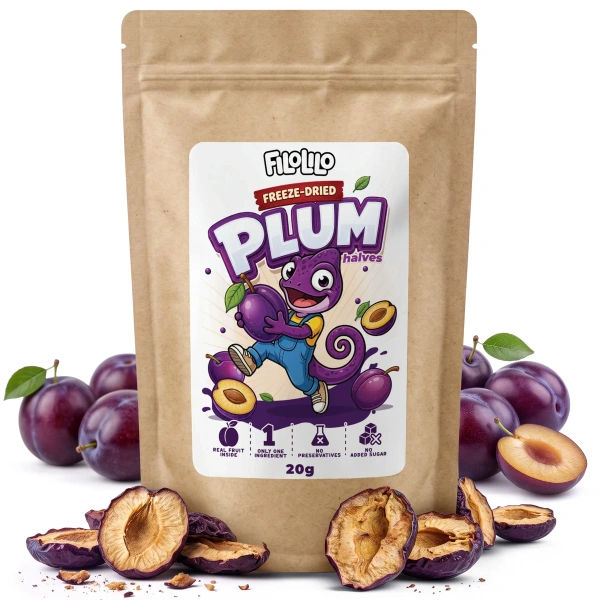
💜 FiloLilo freeze-dried plums (halves)
Freeze-dried plum halves stand out from other fruits thanks to their distinctive profile – they are noticeably sweeter, with a texture that can differ from that of delicate berries. They are an excellent choice when you are in the mood for a filling, natural snack. In this form, the plums also work particularly well in homemade baked goods, cakes and as a fruity base for homemade compotes.
See the product: FiloLilo freeze-dried plum halves 20 g
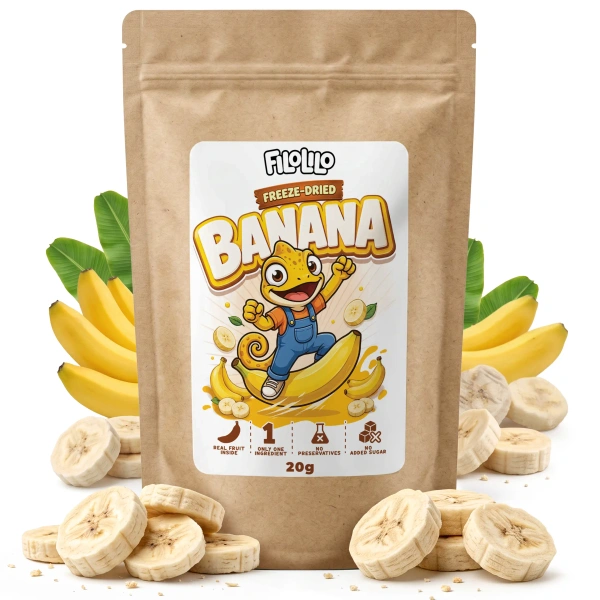
🍌 FiloLilo freeze-dried bananas (slices)
Freeze-dried bananas in slices are a real favourite, enjoyed by both adults and children. They offer a satisfying crunch and gentle sweetness that comes entirely from the fruit itself. They are a convenient alternative to traditional crisps, ideal for an evening snack, at work or as easy-to-eat carbohydrates after physical activity.
See the product: FiloLilo sliced freeze-dried bananas 20 g
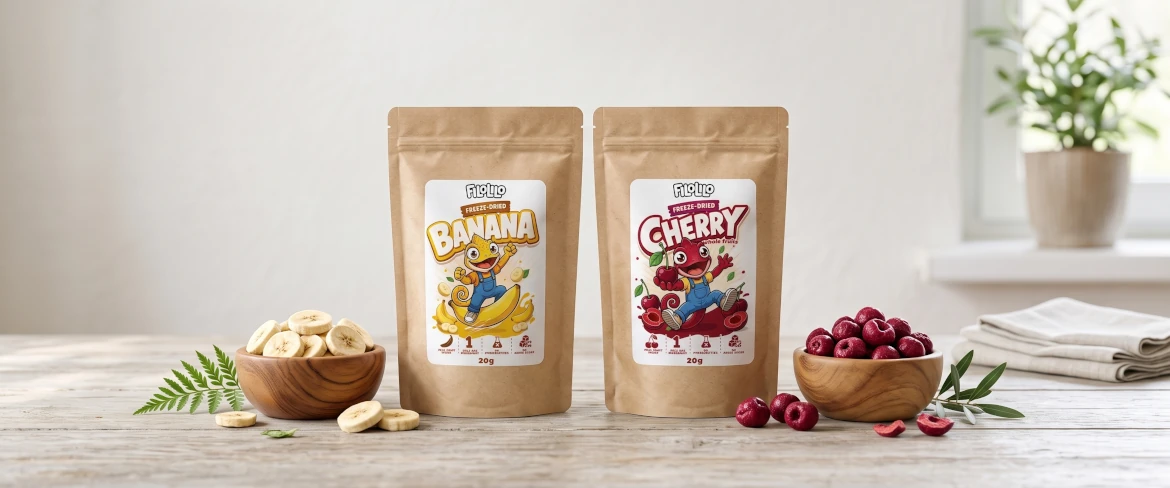
The variety of forms and flavours available from FiloLilo makes it easy to choose products that fit your everyday needs. Whether you choose whole fruit to enjoy as a crunchy snack or convenient slices to enhance desserts, you can be confident that you are choosing a pure, entirely natural product.
FiloLilo – when is it worth choosing a particular pack size?
Are you wondering which pack size would suit you best? To meet different needs, FiloLilo freeze-dried fruit is available in two convenient options – 20 g and 100 g. Each option is designed for different situations and uses, so the right choice mainly depends on your lifestyle and how often you plan to enjoy it.
Small 20 g packs – a single-serving snack
Smaller packs are all about convenience and portability. A 20 g pack is a carefully measured portion that is ideal for taking with you away from home. Remember that during the freeze-drying process, water is removed from the fruit, making it very light – so 20 g actually corresponds to a much larger amount of fresh fruit.
When is this option most useful?
- ✔️ On the go and while travelling – the light, compact pack fits easily into any bag or rucksack.
- ✔️ At school or work – a convenient way to enjoy a satisfying snack that does not make your hands sticky and is ready to eat straight away.
- ✔️ For portion control – an excellent option if you are mindful of what you eat and prefer to have one clearly defined portion ready for a particular moment.
Larger 100 g packs – for the kitchen and keeping in stock
If freeze-dried fruit is a regular part of your daily diet or you enjoy experimenting with it in the kitchen, 100 g packs are a more cost-effective and practical choice. This economical option allows you to enjoy your favourite flavour for much longer.
A larger pack is ideal:
- ✔️ for everyday cooking – as a regular addition to morning porridge, muesli, yoghurt or smoothies,
- ✔️ for baking and desserts – the larger quantity gives you plenty of freedom when decorating cakes, preparing creams and making homemade sweet treats,
- ✔️ as a household supply – the high-quality doypack with a practical zip fastening protects the product from moisture. You can open and close it repeatedly while keeping the fruit crispy for longer.
📌 Summary:
Whether you need a convenient snack to take with you or a practical supply for your kitchen, FiloLilo gives you a choice. The 20 g option offers maximum convenience, while the 100 g pack is an economical everyday solution. Most importantly, both options contain a completely natural product of excellent quality!

How to eat freeze-dried fruit and how to use it?
We have covered the theory, so now it is time to move on to practical ideas! Freeze dried fruit – how to eat it and how to use it in everyday cooking? The good news is that there are plenty of possibilities, while convenience and versatility are among its greatest advantages.
Thanks to its light, crispy texture and intense flavour, freeze-dried fruit works equally well as a quick snack and as an addition to many dishes. It requires no preparation, processing or special storage conditions – simply open the pack and it is ready to use.
Freeze-dried fruit – how to eat it every day?
The simplest way? Just enjoy it as you would a classic snack. Freeze-dried fruit is light, crispy and naturally sweet, making it an excellent substitute for sweets and processed snacks. This is especially useful for people who want to reduce their sugar intake without giving up the pleasure of eating something sweet.
Importantly, freeze-dried fruit requires no preparation – there is no need to wash, peel or cut it. This makes it ideal for busy days when quick and convenient access to a satisfying snack matters most.
You can include it in your daily diet in a number of ways:
- ✔️ as a quick snack – for work, school or travelling,
- ✔️ as an addition to porridge, muesli or yoghurt,
- ✔️ as part of sweet breakfasts, for example with semolina or rice pudding,
- ✔️ as a crunchy topping for crêpes, waffles or pancakes.
It is also worth remembering that, thanks to its texture, freeze-dried fruit can be enjoyed in two ways – dry, as a crispy snack, or added to moist foods, where it softens slightly and resembles fresh fruit. This gives you even more ways to use it every day.
As it does not require refrigeration and has a long shelf life, you can always keep it close at hand – in the kitchen, your bag or your rucksack. This convenience is exactly what makes freeze-dried fruit such a good fit for everyday life!
What can you add freeze-dried fruit to?
If you are wondering what freeze-dried fruit can be used for, the answer is: almost anything where you want to add natural flavour, colour and a subtle fruity note. Thanks to its intense flavour, even a small amount can noticeably enhance the taste of a dish.
Importantly, freeze-dried fruit is highly versatile – it works just as well with simple everyday meals as it does with more elaborate desserts and drinks.
🍽️ How to use freeze-dried fruit?
Below you will find several tried-and-tested ideas showing how easy it is to include freeze-dried fruit in your everyday menu – both in simple meals and more creative recipes:
- ✔️ in porridge, millet porridge and granola – to naturally enhance flavour and colour,
- ✔️ in cakes, muffins and desserts – as an ingredient or decoration,
- ✔️ in smoothies and shakes – for an intense fruity aroma,
- ✔️ as a decoration for cakes, ice cream and desserts,
- ✔️ in drinks – for example as an addition to tea, lemonade or yerba mate.
This versatility is what makes freeze-dried products so useful in a variety of kitchen situations – from quick breakfasts to more creative culinary experiments.
Ideas for using freeze-dried fruit: breakfasts, desserts and snacks
Here are a few quick ideas that you can try in your kitchen straight away. These simple suggestions require no complicated preparation and offer an easy way to use freeze-dried fruit in your everyday menu:
- 🥣 breakfast: porridge with yoghurt, honey and freeze-dried raspberries – quick, filling and full of flavour;
- 🍰 dessert: cheesecake, cream or pudding with crushed freeze-dried strawberries, adding natural sweetness and colour;
- 🥤 drink: a smoothie with banana and freeze-dried fruit powder – full of flavour and very easy to prepare;
- 🍫 snack: dark chocolate with crunchy fruit – a simple way to enjoy something sweet in a better version;
- 🧉 yerba mate: an infusion with freeze-dried cherries for a natural aroma and a subtle fruity note.
These are just a few examples – in practice, how you use freeze-dried fruit depends largely on your creativity. It works equally well in simple everyday meals and more experimental flavour combinations.
Thanks to its convenient form, freeze-dried fruit is easy to use and requires no preparation, so you can easily incorporate it into your routine – whether you are making a quick breakfast, a weekend dessert or a snack on the go. As you can see, freeze-dried fruit is not just a snack, but also a highly versatile ingredient that can be easily adapted to your preferences.

Freeze dried fruit for children – is it a good choice?
In the diet of the youngest, simplicity of ingredients and product quality are key – which is why more and more parents are paying attention to natural snacks. Freeze dried fruit for children can be a good addition to the diet, provided that we choose high-quality products and serve them in an appropriate form. Because these are most often 100% fruit with no added sugar or preservatives, they are an interesting alternative to sweets and processed snacks.
Their major advantage is convenience – they are light, do not make a mess and require no preparation, which makes them perfect as a snack for school, a walk or a trip. Additionally, they retain some vitamins and nutrients, which makes them a valuable addition to a child’s daily diet – especially when it is difficult to include fresh fruit during the day.
However, it is worth paying attention to a few important aspects. Due to their crispy and light form, freeze dried fruit for children should be introduced gradually. For younger children (e.g. under the age of 3), it is safer to serve them in a crushed form or as an addition to yoghurt, porridge or oatmeal. Older children can easily handle the crunchy texture, but it is still important to observe how they react and how they eat.
Portion size is also important – due to the lack of water, the fruit is more concentrated, so it is easy to eat more than it seems. It is best to treat them as an addition or a variation in the diet rather than a main snack consumed in large quantities.
In summary: freeze dried fruit for children can be a healthy, convenient and appealing snack option, as long as we choose products without additives, pay attention to quality and serve them in moderation, adjusting the form to the child’s age.
Freeze dried fruit – where to buy and how to choose a good producer?
Now that you know what freeze dried fruit is, how to eat it and what its properties are, a natural question arises: where to buy freeze dried fruit and what should you pay attention to when choosing?
Above all, it is worth choosing trusted shops with a carefully selected range of products, such as our MateMundo shop. Here you will find not only a wide range of healthy food products with transparent ingredients, but also FiloLilo freeze-dried fruit – a brand we are proud to stand behind!
When choosing, pay attention to a few key aspects:
- ✔️ ingredients – the best products are 100% fruit, with no added sugar or preservatives,
- ✔️ product form – pieces, powder or whole fruit, depending on the intended use,
- ✔️ quality of raw materials – the better the fruit at the start, the better the final result,
- ✔️ packaging – airtight and protecting against moisture (this is crucial for freeze dried products).
When it comes to freeze-dried fruit, choosing a reputable producer is essential not only for flavour, but also for product quality and safety. It is therefore worth choosing trusted sources and reading labels carefully – especially if you value a clean, simple composition. That is precisely why the FiloLilo brand has joined our online shop, maintaining the highest standards at every stage of production.
As you can see, freeze dried fruit is a convenient, versatile and valuable snack option that can easily become part of your daily diet – regardless of your lifestyle or culinary preferences.
Choose your favourite flavours and see how easy it is to include more fruit in your daily diet!
❓ FAQ – frequently asked questions about freeze dried fruit
1. What is freeze dried fruit?
2. Are freeze dried fruits healthy?
3. Do freeze dried fruits contain a lot of sugar?
4. Freeze dried fruit – how to eat it?
5. What can freeze dried fruit be used for?
6. What is the difference between freeze dried and dried fruit?
7. Do freeze dried fruits lose vitamins?
8. Freeze dried fruit – how many calories does it have?
9. Is freeze dried fruit suitable for children?
10. Where to buy freeze dried fruit?
Sources of information:
- Wikipedia: Freeze-drying.
- A. Michalska et al., Effect of different drying techniques on physical properties and antioxidant capacity of fruits, LWT – Food Science and Technology, 2017.
- C. Ratti, Hot air and freeze-drying of high-value foods: a review, Journal of Food Engineering, 2001.
- Freeze-Dried Foods Nourish Adventurers and the Imagination, spinoff.nasa.gov, 2020.
Recommended

FiloLilo – Freeze-dried strawberry slices 100g

FiloLilo – Freeze-dried whole pitted cherries 100g

FiloLilo – Freeze-dried raspberries 100g
