
Lion’s mane mushroom – what is it, properties and how to use it
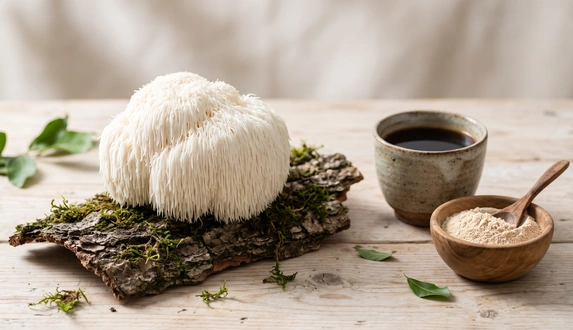
A white, fluffy mass covered with hundreds of hanging spines – this is lion’s mane, one of the most distinctive mushrooms you can come across on tree trunks. Its common name, lion’s mane, describes this shaggy appearance well. For years it has interested cooks, naturalists and scientists, and more and more often it is also used in food supplements, in the convenient form of a powder. Where does its popularity come from? What is actually known about its composition and how it is used? In this post, we explain what lion’s mane mushroom is, where it grows, what natural compounds it contains and how lion’s mane powder differs from an extract.
First, we have collected the basic information about the species: its names, appearance and the places where it grows. Then we move on to its composition, the forms available in shops and how to read the label of a lion’s mane product. At the end, we present Magic Pwdr Lion’s Mane – a powdered extract from lion’s mane fruiting bodies, which you can easily add to coffee, tea or yerba mate. You will find this and other mushroom products in the Mushrooms category.
Table of contents:
- What is lion’s mane mushroom?
- Lion’s mane mushroom – key facts
- Lion’s mane properties
- Lion’s mane – effects and uses
- Lion’s mane powder or extract?
- Magic Pwdr Lion’s Mane – lion’s mane mushroom extract
What is lion’s mane mushroom?
Lion’s mane is a species of mushroom that grows on the wood of broadleaved trees. It is an edible mushroom, known in many parts of the world – in Japan it is called yamabushitake. It is also increasingly used as an ingredient in food supplements. It has such a distinctive appearance that it is hard to confuse with any other mushroom, and its names describe this appearance. Below, we explain what the different names mean, how to recognise the mushroom and where you can find it.
Lion’s mane and Hericium erinaceus – are they the same mushroom?
Yes. Lion’s mane is a common name of the species Hericium erinaceus. The Latin name is the same in all languages, and it is the one worth checking on the label, because producers use various common names. On packaging and in shops, you may therefore see “lion’s mane”, “lion’s mane mushroom”, “hericium” or “yamabushitake” – each time it is the same mushroom.
The name lion’s mane refers to the mane of a lion. The spines of the fruiting body also resemble the spines of a hedgehog. These descriptions all refer to the same thing: the dense, long spines that cover the fruiting body.
💡 Fun fact: The Latin name of lion’s mane is doubly “spiny”. Both the genus name Hericium and the species name erinaceus mean “hedgehog” in Latin.
What does lion’s mane look like?
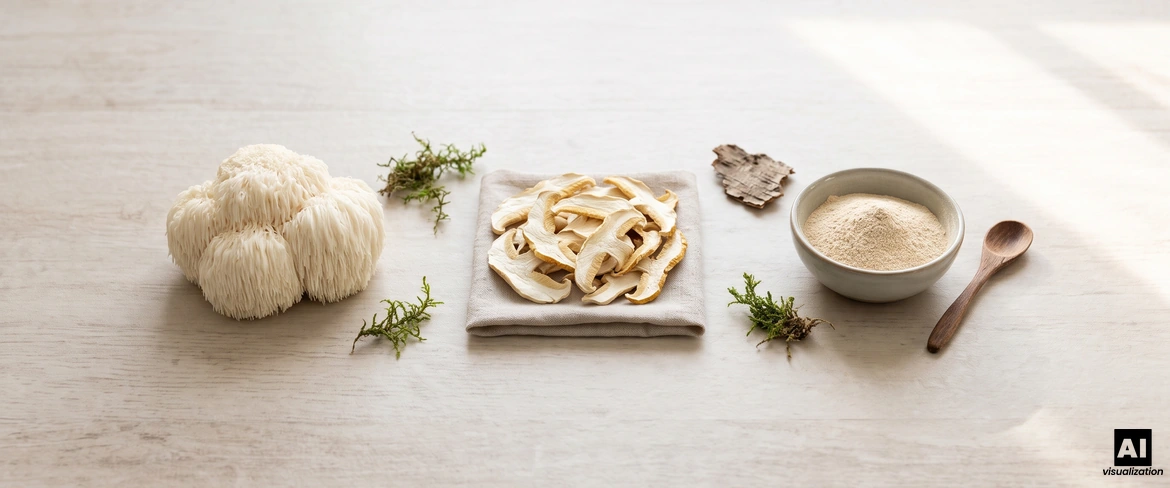
The fruiting body of lion’s mane does not have the cap and stem typical of mushrooms. It is a white, rounded mass from which many soft spines hang down. They resemble icicles or a hedgehog’s spines. Young fruiting bodies are snow white, and with age they turn yellow and brown.
The spines are not just decoration. Spores, which the mushroom uses to reproduce, form on their surface. In most well-known mushrooms, this function is performed by gills or tubes under the cap, while in lion’s mane it is performed by the hanging spines.
Where does lion’s mane grow?
In nature, lion’s mane grows on the trunks and branches of broadleaved trees – including oaks, beeches, maples, walnuts and elms. It most often chooses dead or dying trees, because it feeds on decaying wood, although sometimes it behaves like a weak parasite. It occurs in Europe, Asia and North America, but everywhere it needs old trees. When there are fewer of them, there is also less lion’s mane, which is why in many European countries it has appeared on red lists of fungi, and in some, wild specimens are protected by law. It is therefore better not to pick lion’s mane found in a forest, but simply to admire it.
The lion’s mane that you find in shops usually comes from cultivation. The mushroom is grown on a substrate of broadleaved tree sawdust with additions, for example bran, and scientists are also testing substrates made from straw. Thanks to cultivation, fruiting bodies are available all year round and have consistent quality, while wild sites remain untouched. The raw material for fresh mushrooms, dried mushrooms, powders and extracts comes from such cultivation.
💡 Fun fact: Lion’s mane is also of interest to makers of plant-based alternatives to meat and seafood. Swiss researchers combined it with pink oyster mushroom and prepared a plant-based shrimp alternative. The texture of the prototype was similar to fried shrimp, although the authors admit that the recipe still needs improvement.
💬 Scientific source: F. Meyer et al., Vegan shrimp alternative made with pink oyster and lion's mane mushrooms: Nutritional profiles, presence of conjugated phenolic acids, and prototyping, Current Research in Food Science, 2023.

Lion’s mane mushroom – key facts
When you start looking for products with lion’s mane, you will quickly notice that the packaging looks similar, while the descriptions differ a lot. One producer writes about lion’s mane, another about Hericium, one uses fruiting bodies, another mycelium, and you can choose between powders, extracts and capsules. In this section, we put this information in order: we explain which names you may come across, how the parts of the mushroom used in production differ and in what forms lion’s mane reaches the shops.
Latin name and other names
The full Latin name of lion’s mane is Hericium erinaceus. On labels and in publications, the same species appears under several names:
- ➡️ lion’s mane or lion’s mane mushroom – a common name, often used in product names too,
- ➡️ hericium – short for the Latin name,
- ➡️ yamabushitake – the Japanese name,
- ➡️ bearded tooth fungus – another English name, less common.
As there are so many names, the Latin name remains the most reliable point of reference. It is worth paying attention to its second part, because the genus Hericium also includes other species, for example Hericium coralloides. If you see Hericium erinaceus on the packaging, you can be sure that the product contains lion’s mane.
Fruiting bodies and mycelium of lion’s mane – what is the difference?
A mushroom consists of two main parts. The fruiting body is the part we see on the tree trunk – in the case of lion’s mane, a white mass with spines. The mycelium is a network of thin threads that grow inside the wood or the growing substrate and take nutrients from it. The fruiting body grows from the mycelium only when the mushroom has the right conditions to produce spores.
For someone choosing a lion’s mane product, this difference has practical importance. Fruiting bodies and mycelium differ in composition: in scientific publications, hericenones are described mainly as compounds of fruiting bodies, and erinacines as compounds of mycelium. Products made from fruiting bodies and from mycelium should therefore not be treated as substitutes for each other. The difference also applies to regulations: in the European Union, lion’s mane fruiting bodies were consumed to a significant degree before 1997, so they are not treated as a novel food. Dried mycelium was assessed differently, as no such history of consumption has been shown for it.
That is why it is always worth checking on the label which part of the mushroom the raw material comes from. The producer may state this directly (“from fruiting bodies”, “from mycelium”) or give it in the ingredients. In Magic Pwdr Lion’s Mane, this is clearly stated: the product contains a 10:1 extract from lion’s mane fruiting bodies (Hericium erinaceus).
🔍 Good to know: Hericenones and erinacines are compounds typical of lion’s mane, but they are not found in it evenly. In one study, the researchers point out that hericenones were usually found in fruiting bodies, while erinacines came from mycelium – no erinacines were found in the fruiting body.
💬 Scientific source: I.-C. Li et al., Neurohealth Properties of Hericium erinaceus Mycelia Enriched with Erinacines, Behavioural Neurology, 2018.
What forms does lion’s mane come in?
Lion’s mane is available in several forms. Each of them works best in a different situation:
- ➡️ fresh fruiting bodies – they are prepared like other edible mushrooms, for example fried or stewed; they do not keep well and are harder to find,
- ➡️ dried mushroom – sliced and dried fruiting bodies that can be stored for longer and soaked before use in the kitchen,
- ➡️ powder – ground dried fruiting bodies (or mycelium), which you add to drinks and dishes,
- ➡️ extract – a preparation made from the mushroom by extraction, most often in powder form, in which there is more raw material per unit of weight than in an ordinary powder,
- ➡️ capsules – powder or extract enclosed in measured portions.
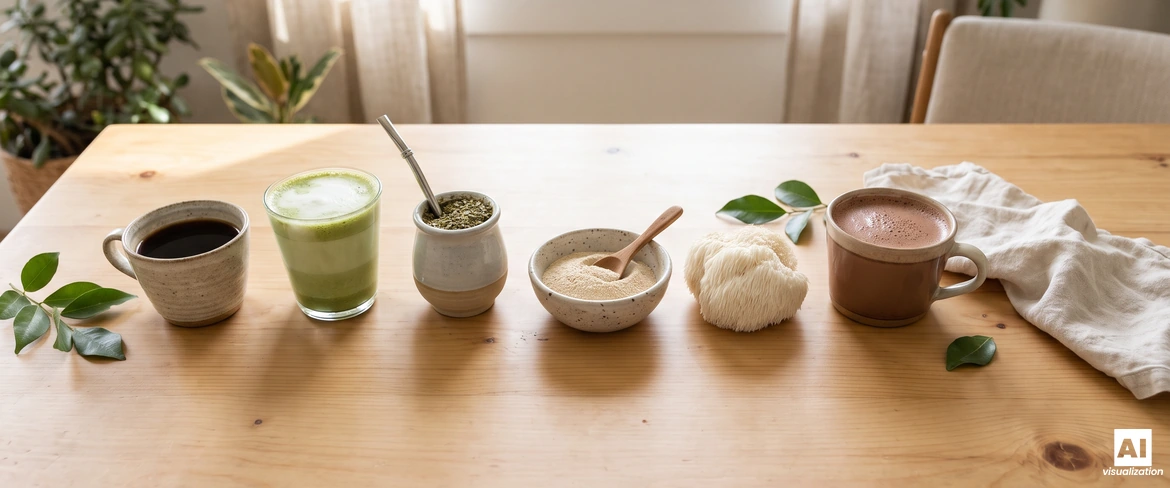
The form of the product determines how you will use it. Capsules are convenient when you want a ready-measured portion and do not need to combine it with food. Lion’s mane powder gives you more freedom: you stir it into coffee, tea, yerba mate, cocoa, a smoothie or porridge, and you decide when and with what you take it. An extract in powder form gives the same freedom, and its serving is small, so it is easy to add to a drink. You will find the lion’s mane products we offer in the Mushrooms category.
You will find lion’s mane powder that you can stir into your morning coffee, tea or yerba mate in our mushroom category.
Browse mushroom powdersIf you prefer ready-made combinations, also take a look at the Magic Pwdr drinks, in which lion’s mane extract is combined with matcha, yerba mate or cocoa.
We recommend
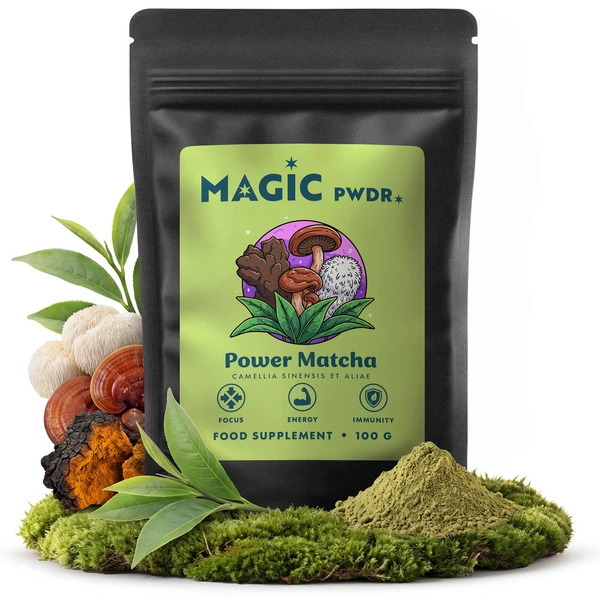
Matcha with lion’s mane, chaga and reishi extracts, lightly sweetened – a good base for matcha latte and iced matcha.
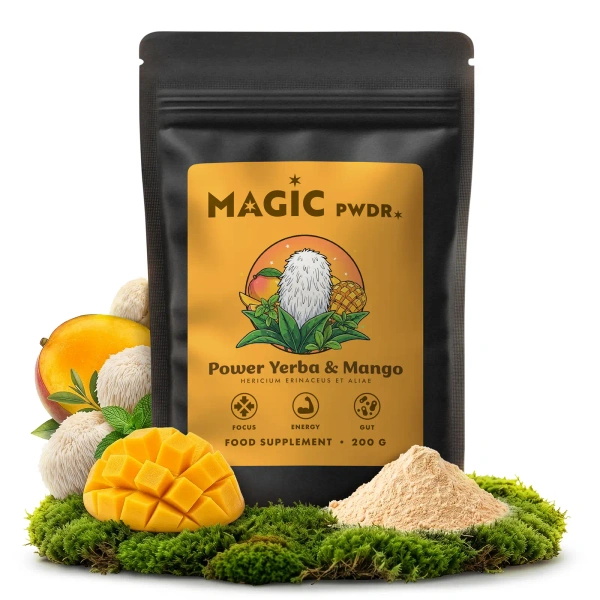
Magic Pwdr Power Yerba & Mango 200 g
Extracts from yerba mate and lion’s mane with a mango flavour – just mix with water, milk or a plant-based drink.
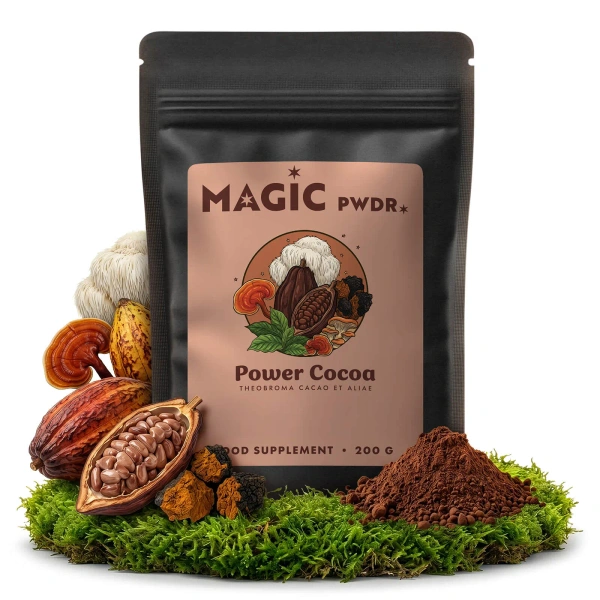
Cocoa with 10:1 extracts from lion’s mane, chaga and reishi fruiting bodies – the chocolate flavour covers the earthy notes of the mushrooms well.
Lion’s mane properties
When we talk about the properties of lion’s mane, we start with what can be checked and described: its composition. The fruiting bodies of lion’s mane contain quite a lot of protein – in one of the batches studied, it made up about 26% of dry weight. In addition, lion’s mane contains polysaccharides and compounds characteristic of this species, described in scientific publications. Remember, however, that the composition of lion’s mane as a food supplement should not be equated with an effect on health. Below, we explain which natural compounds it contains and what determines their amount in the finished product.
Natural compounds present in lion’s mane
Scientific publications most often mention several groups of natural compounds in lion’s mane. Each of them is described in a different context:
What does lion’s mane contain?
| Compounds | What they are | Where they are found mainly |
|---|---|---|
| polysaccharides, including beta-glucans | long chains of sugars that build, among other things, the cell walls of mushrooms | fruiting bodies and mycelium |
| hericenones | compounds characteristic of lion’s mane | mainly fruiting bodies |
| erinacines | compounds characteristic of lion’s mane | mainly mycelium |
| protein | a basic nutrient of edible mushrooms | fruiting bodies |
The amount of these compounds in a specific product is not constant. The composition depends above all on which part of the mushroom was used – fruiting bodies or mycelium. The extraction method is also important: whether the raw material was extracted with water or alcohol, at what temperature and for how long. Growing conditions and production parameters count as well. That is why, in scientific sources, the polysaccharide content of different lion’s mane samples varies greatly and it is difficult to give one universal value. It is similar with other mushrooms, for example chaga – we wrote about its composition and forms in the post Chaga mushroom – what is it, what are its properties and how to use it?
💡 Fun fact: Lion’s mane can be grown on a large scale on cheap substrates. The authors of a scientific review from 2023 point out that further research and standardisation are needed for lion’s mane supplements. From our perspective, this is another reason to check on the label which part of the mushroom the raw material comes from and in what ratio the extract was made.
💬 Scientific source: I. Szućko-Kociuba et al., Neurotrophic and Neuroprotective Effects of Hericium erinaceus, International Journal of Molecular Sciences, 2023.
Lion’s mane – effects and uses
The question about the effects of lion’s mane comes up very often – usually in the form “what is lion’s mane used for?” or “what are lion’s mane effects?”. An honest answer starts with the mushroom itself: how it is used, where its popularity comes from and what is known from scientific research. In this section, we also explain what you should not expect from it.
What is lion’s mane used for?
Lion’s mane is used above all as an ingredient in food supplements. It most often comes in the form of a powder or an extract, which is added to everyday drinks and meals, or in capsules. Many people treat it as part of mindful eating: a way to add variety to a morning coffee, tea or yerba mate and a way to include mushrooms in the diet in a convenient form. Fresh and dried fruiting bodies are also used in the kitchen, where they are prepared like other edible mushrooms.
It is worth knowing that in the European Union there are no approved health claims for lion’s mane, so we do not attribute any specific effect on health to it. A lion’s mane supplement does not treat any condition and does not replace therapy. It also cannot replace a varied diet or a healthy lifestyle.
Before reaching for a supplement, it is also worth checking the contraindications given by the producer. On the label of Magic Pwdr Lion’s Mane, you will find the information that the product is not recommended for pregnant women, breastfeeding women and people under 18. It should also not be used in case of hypersensitivity to any of the ingredients. If you take medicines or have doubts about whether the supplement is suitable for you, ask a doctor or pharmacist.
Lion’s mane and everyday mental activity
Lion’s mane has become especially popular among people with mentally demanding days: students, people who work at a computer, programmers and everyone whose day is filled with study, projects and meetings. In this group, it is popular to add mushroom powders to a morning coffee, matcha or yerba mate. For many people, it is simply part of a daily routine – like choosing a favourite tea or a way of brewing coffee.
Regardless of trends, in periods of intensive work or study the basics remain sleep, a balanced diet, rest and exercise. A lion’s mane supplement does not replace a varied diet or a consultation with a doctor if something about how you feel worries you. We simply treat lion’s mane as an ingredient of everyday drinks.
We recommend
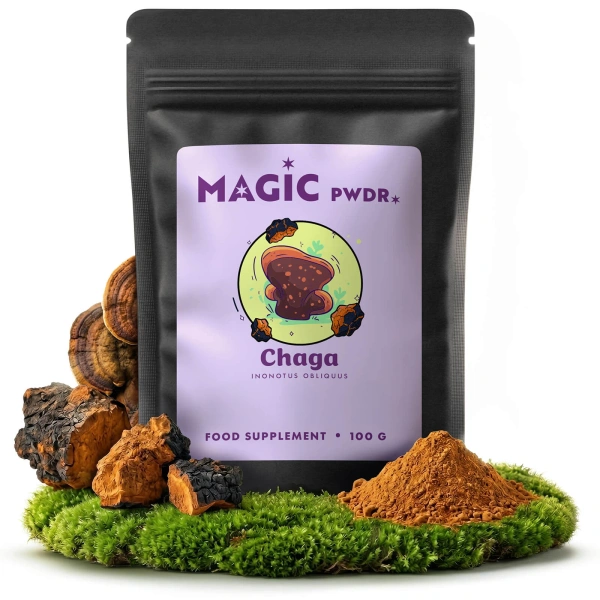
100% 10:1 extract from chaga fruiting bodies with an earthy, slightly vanilla taste – it goes well with coffee and cocoa.
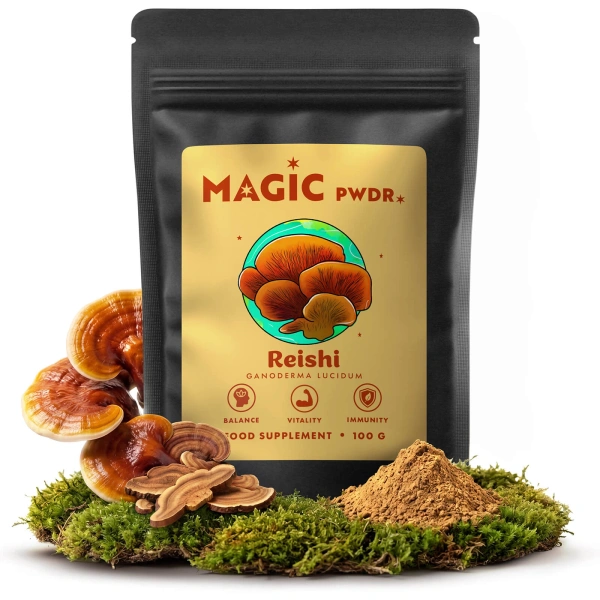
100% 10:1 extract from reishi fruiting bodies – its distinctive, slightly bitter taste goes well with coffee, cocoa or a smoothie.
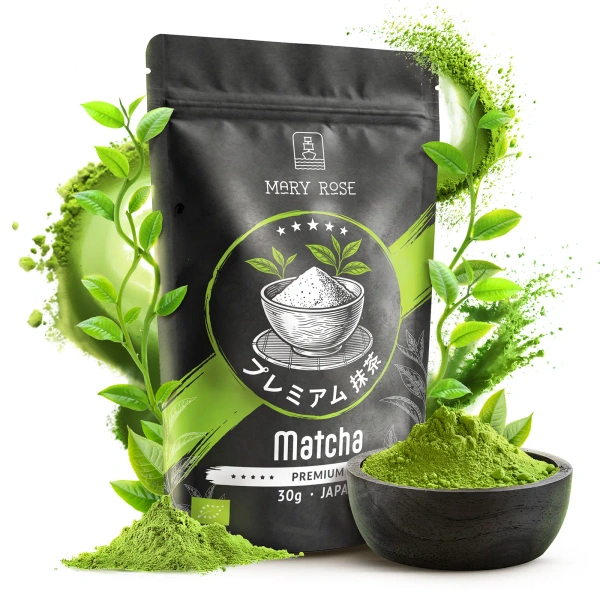
Japanese Matcha BIO Premium 30 g
Organic matcha with no sugar or flavourings, to drink with water or as a latte – a good base to which you can add a portion of mushroom powder.
Does lion’s mane improve memory and concentration?
This is one of the most common questions about lion’s mane – and it is exactly here that it is particularly easy to oversimplify. We do not present lion’s mane as something that improves memory or concentration. The popularity of a mushroom on the internet and on social media is not the same as a confirmed effect. As we have already mentioned, in the European Union lion’s mane has no approved health claims.
Lion’s mane is studied by scientists, but this research is still at an early stage. Most publications are laboratory studies and experiments on animals, whose results cannot be applied directly to humans. There are few studies involving people. A systematic review from 2025 found only five randomised trials and three pilot studies in total. These are often small groups of participants, different products (from fruiting bodies, from mycelium, mixtures) and different ways of assessing the results. That is why the authors of the reviews stress that larger and better designed studies are needed.
💬 Scientific source: A. Menon et al., Benefits, side effects, and uses of Hericium erinaceus as a supplement: a systematic review, Frontiers in Nutrition, 2025.
Using a lion’s mane supplement is therefore worth considering in a broader context – as one element of a daily diet and lifestyle, and not a promise of a specific result. One of the pilot studies described below shows well what such research looks like in practice.
🔍 Good to know: In a pilot study from 2023, 41 healthy people aged 18-45 took a lion’s mane preparation or a placebo for 28 days. The authors openly write that some of the tests showed no differences between the groups, and that, because of the small number of participants, the results should be interpreted with caution. This is a good example of what research on lion’s mane looks like: it is interesting, but it does not allow strong conclusions.
💬 Scientific source: S. Docherty et al., The Acute and Chronic Effects of Lion's Mane Mushroom Supplementation on Cognitive Function, Stress and Mood in Young Adults: A Double-Blind, Parallel Groups, Pilot Study, Nutrients, 2023.
Lion’s mane powder or extract?
In shops, you will most often come across two loose forms of the mushroom: lion’s mane powder and lion’s mane extract. They look similar – it is a fine powder in a pouch or a small jar. However, they differ in the way they are produced, the concentration of raw material and the size of the serving. Powder is simply a dried and ground mushroom. An extract is made in the process of extraction: selected components are drawn out of the mushroom, and the resulting extract is most often dried into a powder. We have collected the most important differences in a table.
Powder vs extract of lion’s mane
| Feature | Powder | Extract |
|---|---|---|
| what it is | a dried and ground mushroom | a preparation made from the mushroom by extraction, usually dried into a powder |
| concentration of raw material | 1 g of powder is about 1 g of dried mushroom | depends on the extract ratio, e.g. at 10:1, 1 g of extract corresponds to about 10 g of raw material |
| serving size | usually larger | usually smaller |
| preparation | for drinks, smoothies and dishes | for drinks, smoothies and dishes; a small serving easily disappears in a drink |
| what to check on the label | the part of the mushroom, the serving, additives | the part of the mushroom, the extract ratio, the serving, additives |
The 10:1 marking, which you can see on many packs, describes the ratio of raw material to the finished extract. It means that 10 parts of mushroom were used to obtain 1 part of extract – for example, about 10 kg of dried fruiting bodies per 1 kg of extract. Thanks to this, the serving of extract can be small and still correspond to a much larger amount of raw material. However, such a ratio does not tell the whole story. The quality of the raw material also counts, as do the part of the mushroom used, what was used for the extraction and for how long, and whether carriers or fillers were added to the extract. That is why 10:1 should not be read as “10 times stronger”.
💡 Fun fact: The ratio of raw material to extract is given on the packaging of many plant and mushroom extracts, but it is not always easy to read correctly. The authors of a paper devoted to this subject write plainly that such a ratio can be misleading if its meaning is not understood. The number alone does not say which solvent was used or what exactly ended up in the extract.
💬 Scientific source: M. Monagas et al., Understanding plant to extract ratios in botanical extracts, Frontiers in Pharmacology, 2022.
If you are wondering which lion’s mane is the best, do not look for one answer for everyone. It is better to check whether the product suits your habits and whether the label gives you complete information. Before buying, pay attention to:
- ✔️ the Latin name – Hericium erinaceus confirms that it is lion’s mane,
- ✔️ the part of the mushroom – whether the raw material comes from fruiting bodies or from mycelium,
- ✔️ the form and ratio – whether it is a powder or an extract, and if it is an extract, in what ratio,
- ✔️ the full ingredients – whether, apart from the mushroom, it contains other ingredients, carriers or fillers,
- ✔️ the serving and how to prepare it – how much product makes up a serving, how many servings the producer recommends per day and what it can be combined with,
- ✔️ the number of servings in the pack – it makes it easier to compare the prices of different products,
- ✔️ warnings – who the product is not intended for.
The question about lion’s mane dosage is always answered by the label of the specific product. The serving of a powder and of an extract can differ greatly, so it is not a good idea to apply recommendations from one pack to another. You can read more about how to read the ingredients of mushroom supplements – reishi, chaga and lion’s mane – in a separate post on choosing mushroom supplements.
Are you looking for an extract from fruiting bodies with a clearly stated ratio, serving and short ingredient list? Check Magic Pwdr Lion’s Mane 100 g.
View Lion’s Mane 100 gThe choice between a powder and an extract therefore depends above all on how you want to use lion’s mane. If you want a small serving that you can quickly mix with coffee, tea or yerba mate, an extract will be more convenient. If you prefer to treat the mushroom as an ingredient of dishes and a larger serving does not bother you, an ordinary powder will work. In both cases, the most important thing is a clear label.
Magic Pwdr Lion’s Mane – lion’s mane mushroom extract
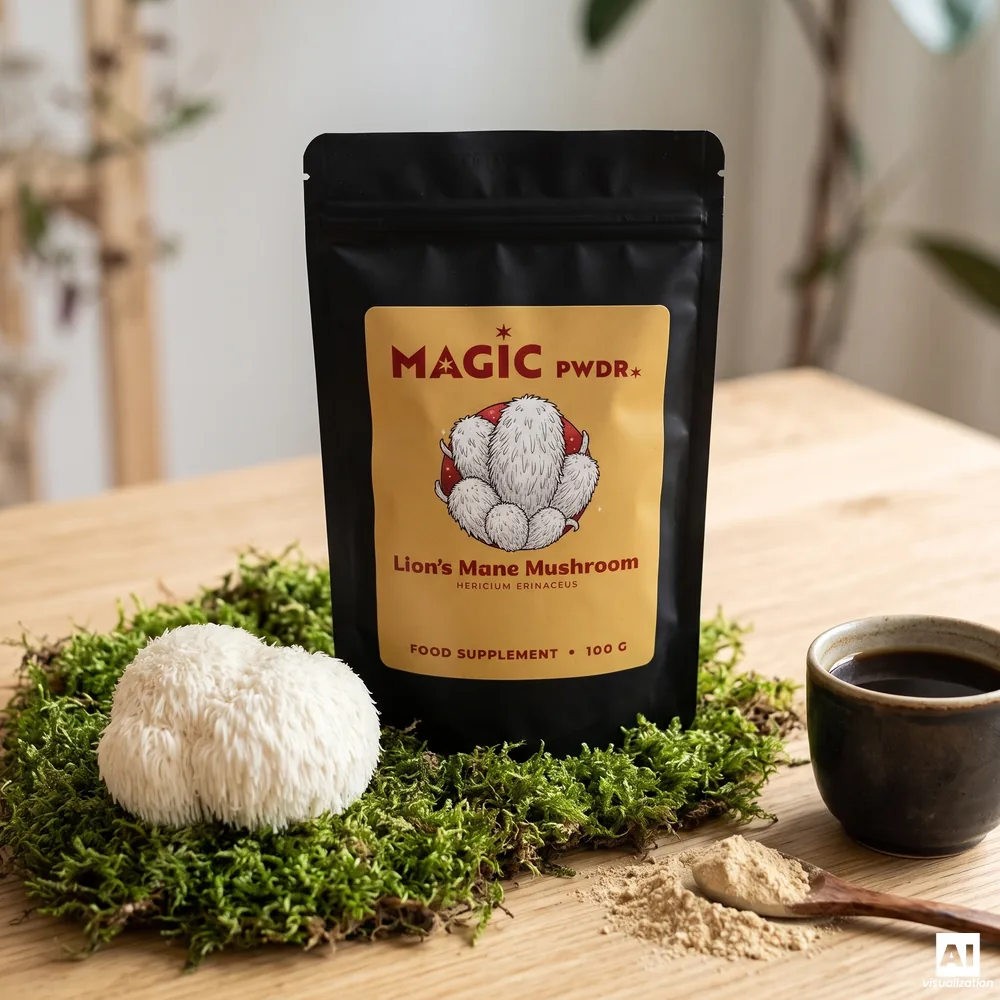
Now that you know what lion’s mane is and what to look for on the label, it is time to present the product you will find in our shop. Magic Pwdr Lion’s Mane is a food supplement containing a powdered extract from lion’s mane fruiting bodies and vitamin C. The Magic Pwdr brand is built around short, transparent ingredient lists and a convenient powder form that is easy to include in everyday drinks.
🍄 Magic Pwdr Lion’s Mane 100 g
This is a lion’s mane extract in the simplest possible form: a fine powder that you stir into coffee, tea, yerba mate or a smoothie. It contains a 10:1 extract from the fruiting bodies of Hericium erinaceus and vitamin C – according to the producer, with no unnecessary additives or fillers.
- ✔️ 10:1 extract from fruiting bodies, not from mycelium,
- ✔️ about 200 servings in a 100 g pack,
- ✔️ a neutral taste that is easy to combine with different drinks,
- ✔️ dissolves in hot and cold drinks.
Ingredients and form of the product
The ingredient list of Magic Pwdr Lion’s Mane is short and given in full on the label. The product contains two ingredients: a 10:1 extract from lion’s mane fruiting bodies (Hericium erinaceus) and L-ascorbic acid, which is vitamin C. According to the producer’s description, it contains no unnecessary additives or fillers. The most important information about the product:
- ➡️ form: powder,
- ➡️ net weight: 100 g,
- ➡️ number of servings: about 200 per pack,
- ➡️ one serving (500 mg): 495 mg of 10:1 extract from lion’s mane fruiting bodies and 5 mg of vitamin C,
- ➡️ recommended daily serving (3 servings): 1485 mg of extract and 15 mg of vitamin C, which is 18.75% of the reference intake.
With the recommended use, that is three servings a day, one pack lasts for more than two months. It is a good choice if you want to include lion’s mane in your daily habits for longer and do not want to keep buying a new pack.
How do I use Magic Pwdr Lion’s Mane?
Using Magic Pwdr Lion’s Mane is simple. Measure out 500 mg of powder, which is about 1/3 of a level teaspoon, and mix it with a drink or meal of your choice. The powder dissolves well in hot and cold drinks, but it is worth mixing it thoroughly. Drink the beverage straight after preparing it. The producer recommends 500 mg three times a day. Do not exceed the recommended daily serving.
Thanks to its neutral taste, it is easy to fit lion’s mane into your own routine. Here are some ways to use lion’s mane mushroom powder. You can add it to:
- ➡️ a morning coffee – black or with milk,
- ➡️ tea and yerba mate – also iced,
- ➡️ matcha – both traditional and matcha latte,
- ➡️ cocoa – we write about how to choose good cocoa in the post Cocoa – properties, types and uses,
- ➡️ a smoothie or porridge – if you prefer to combine lion’s mane with food.
Spread the three servings over the whole day – for example, in the morning in coffee, at midday in yerba mate and in the afternoon in a smoothie. It is important that in total you do not exceed the serving recommended by the producer. Keep the pack out of the reach of small children.
📌 In short:
- ✔️ Lion’s mane and Hericium erinaceus are the same mushroom.
- ✔️ In nature, it grows on the wood of broadleaved trees, and it usually reaches the shops from cultivation.
- ✔️ Fruiting bodies and mycelium differ in composition, so it is worth checking on the label which part of the mushroom the raw material comes from.
- ✔️ A 10:1 extract is the ratio of raw material to the finished extract, not a measure of a product’s “strength”.
- ✔️ Lion’s mane is an ingredient of food supplements – it is not a medicine and does not replace a varied diet or a healthy lifestyle.
- ✔️ Magic Pwdr Lion’s Mane 100 g is a 10:1 extract from fruiting bodies with vitamin C, about 200 servings per pack.
If you want to include lion’s mane in your daily habits, Magic Pwdr Lion’s Mane 100 g is a convenient choice: a short ingredient list, an extract from fruiting bodies and a supply for more than two months of regular use. You will find other mushroom products, including chaga and reishi, in the Mushrooms category.
One serving, a third of a teaspoon, your favourite drink – and lion’s mane becomes part of your daily routine.
❓ FAQ – frequently asked questions about lion’s mane mushroom
1. Is lion’s mane the same as Hericium erinaceus?
2. What is lion’s mane used for?
3. What is the difference between lion’s mane powder and extract?
4. How should I dose lion’s mane powder?
5. What can I mix lion’s mane powder with?
6. Can anyone use a lion’s mane supplement?
7. What does lion’s mane powder taste like?
8. Can I pick lion’s mane in the forest?
Sources of information:
- A. Menon et al., Benefits, side effects, and uses of Hericium erinaceus as a supplement: a systematic review, Frontiers in Nutrition, 2025.
- Z. Lu et al., Optimization of substrate formulation for Hericium erinaceus by replacing wood by straw and their effect on enzyme activities, Frontiers in Plant Science, 2024.
- I. Szućko-Kociuba et al., Neurotrophic and Neuroprotective Effects of Hericium erinaceus, International Journal of Molecular Sciences, 2023.
- S. Docherty et al., The Acute and Chronic Effects of Lion's Mane Mushroom Supplementation on Cognitive Function, Stress and Mood in Young Adults: A Double-Blind, Parallel Groups, Pilot Study, Nutrients, 2023.
- F. Meyer et al., Vegan shrimp alternative made with pink oyster and lion's mane mushrooms: Nutritional profiles, presence of conjugated phenolic acids, and prototyping, Current Research in Food Science, 2023.
- M. Monagas et al., Understanding plant to extract ratios in botanical extracts, Frontiers in Pharmacology, 2022.
- I.-C. Li et al., Neurohealth Properties of Hericium erinaceus Mycelia Enriched with Erinacines, Behavioural Neurology, 2018.
- European Commission, Consultation process on novel food status.
- European Commission, EU Register of nutrition and health claims made on foods.
- Wikipedia: Hericium erinaceus.
Recommended

Magic Pwdr – Chaga 100g

Magic Pwdr – Reishi 100g

Magic Pwdr – Lion's Mane 100g
